
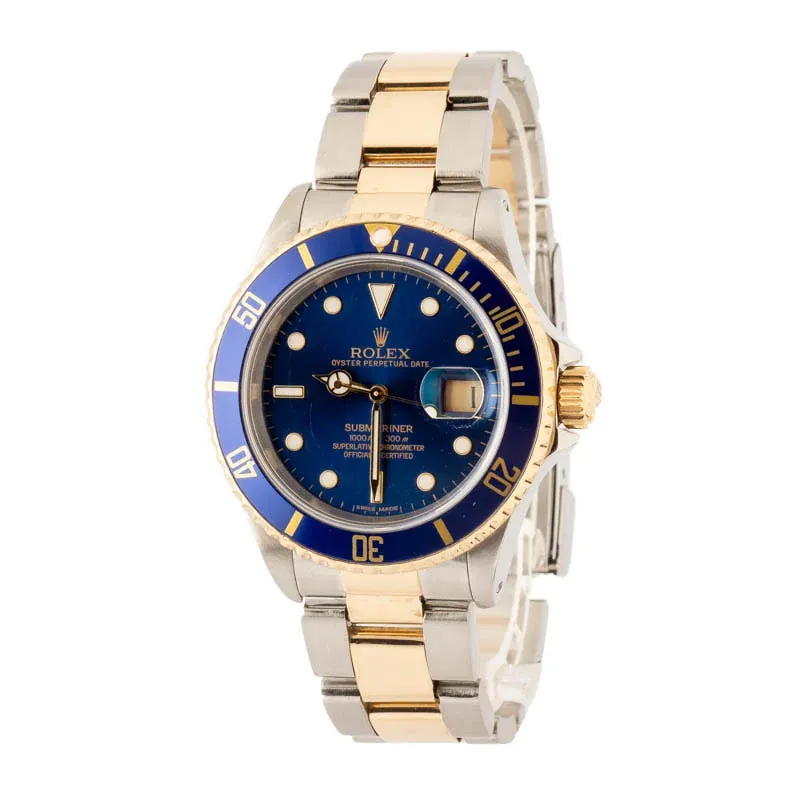
No watch does more than a dive watch. Born as professional tools, divers have become the most versatile luxury watches you can own — equally at home under a wetsuit or a shirt cuff. Here's what makes a true diver, and how to choose the right one.
That versatility is not an accident. A dive watch was designed to be read at a glance in poor light, to survive impact and pressure, and to keep working when it is wet, cold and being knocked against things. Those are exactly the qualities that make a watch pleasant to live with on dry land — which is why the category dominates the pre-owned market, and why, if you are only going to own one mechanical watch, there is a strong argument that it should be this one.
What makes a watch a "real" diver
A genuine dive watch is built to an international standard and shares a few key features: at least 100m (usually 200m+) of water resistance, a unidirectional rotating bezel to track elapsed dive time, strong luminous markers for legibility in the dark, and a robust, screw-down crown. These aren't just for show — they're why divers are so tough and reliable in everyday life.
The standard in question is ISO 6425, the international specification for divers' watches. It sets out what a watch must do before it can legitimately be marked "diver's" on the dial: a minimum 100m rating, legibility of the time from 25cm in total darkness, a pre-selecting device — the bezel — marked at least every five minutes, resistance to magnetism, shock, salt water and thermal shock, and a visible indication that the watch is running in the dark. Crucially, ISO 6425 requires that every single watch is individually tested, not just a sample from the batch.
This is worth knowing because plenty of watches look like divers without meeting the standard — a rotating bezel and a chunky case do not make a diver. Conversely, some unquestionably capable watches skip certification because the brand never sought it. Treat the marking as a useful signal rather than an absolute verdict.
Every feature traces back to a practical problem. The screw-down crown exists because a push-in crown can be pulled out by a snagged sleeve, flooding the movement. The markers are oversized because visibility drops sharply below the surface. The bezel is grippable in gloves because bare hands lose dexterity in cold water.
The features that matter
- Water resistance: 200m is the sweet spot for a do-anything watch. More is bragging rights for most owners.
- Bezel: should turn one way only (so an accidental knock can only shorten, never lengthen, your timed dive) with firm, precise clicks.
- Lume: strong, even glow on the hands and markers. Essential underwater and genuinely useful at night.
- Bracelet and clasp: a solid bracelet with a secure, well-machined clasp — ideally with micro-adjustment.
Water resistance, decoded
Water resistance ratings are one of the most misread specifications in watchmaking. The figure on the dial is a laboratory pressure equivalent, achieved on a new, correctly sealed watch in still water. Real swimming involves movement, which briefly increases pressure beyond static depth, and gaskets age. That is why a 30m rating is not a swimming watch. A genuine diver's rating gives you a margin of safety that survives a few years of gasket wear.
| Rating | What it realistically handles | Typical watch type |
|---|---|---|
| 30m / 3 ATM | Rain, handwashing. Not swimming. | Dress watches |
| 50m / 5 ATM | Showering, brief accidental immersion. | Everyday dress-sport |
| 100m / 10 ATM | Swimming, snorkeling. ISO entry point for divers. | Sports watches, entry divers |
| 200m / 20 ATM | Recreational scuba, anything you will realistically do. | The mainstream diver sweet spot |
| 300m / 30 ATM | Professional and technical diving, generous margin. | Flagship divers |
| 600m and beyond | Saturation diving, usually with a helium escape valve. | Specialist tool watches |
The helium escape valve found on some deep-rated divers deserves a note, because it is widely misunderstood. It is not for keeping water out. It vents helium that has seeped into the case during long saturation dives in a pressurized habitat, preventing the crystal from popping off during decompression. It is a genuine engineering solution to a genuine problem, but it is a problem that belongs to commercial divers, not to you.
Judging a bezel properly
When you handle a diver, spend thirty seconds on the bezel alone. It should rotate counterclockwise only, with even resistance all the way around and no dead spots. Each click should land the marker exactly on a minute index — sloppy alignment is the most common giveaway of cheap construction, and on a pre-owned watch it can indicate a worn click spring. Ceramic inserts resist scratching and fading; aluminum inserts fade, which some buyers dislike and others seek out. Neither is better in the abstract.
Lume and legibility
Modern luminous material is a photoluminescent pigment that charges in light and discharges in the dark. Quality varies enormously between a thick, even application that stays readable for hours and a thin coat that fades in twenty minutes. Look for lume on the hands, the hour markers and the bezel pip — the pip is what tells you where the dive started, so a diver without it is styling rather than tooling.
Case size, wearability and proportion
Dive watches ran large through the 2000s and have been shrinking since. The number on the spec sheet matters less than lug-to-lug length, which determines whether the watch sits within the flat of your wrist or hangs over the edge. A 42mm case with short, curved lugs can wear more comfortably than a 39mm case with long straight ones. Thickness matters too — a thick diver catches on cuffs, which is the difference between a watch you wear to the office and one you leave in the box.
If you are buying without trying, measure the flat top surface of your wrist and treat that as your lug-to-lug ceiling. It is a far more reliable guide than circumference. Weight is the other overlooked variable: a full steel bracelet on a large diver is substantial. Our guide to buying a pre-owned luxury watch covers fit and condition assessment in more detail.
Movements: what is ticking inside
Most luxury divers run an automatic mechanical movement, wound by the motion of your wrist. The things worth caring about are power reserve, whether the movement is chronometer-certified, how well it resists magnetism, and how easy and affordable it is to service in ten years' time. In-house movements carry prestige and often better specifications; well-executed third-party movements are frequently easier and cheaper to maintain. Both are legitimate choices, and we cover the trade-offs in watch movements explained.
Magnetism is a real issue for a watch worn every day around laptops, speakers and phone cases. A magnetized hairspring gains time dramatically and is a common cause of a watch that suddenly runs fast. Modern silicon hairsprings and antimagnetic escapement components have largely solved this in current-generation movements, which is one concrete area where a newer watch outperforms a vintage one.
Quartz divers are excellent tools — more accurate, more shock-resistant, no winding required. They are less collectible, but if the watch is genuinely going into the water regularly, quartz is a rational choice rather than a compromise.
The best dive watches by budget
The icons (higher budget): the Rolex Submariner is the definitive dive watch and the benchmark all others are measured against. The Omega Seamaster Diver 300M brings modern anti-magnetic movements and Bond-approved style.
The value champions: the Tudor Black Bay delivers Submariner spirit and an in-house movement for far less. The Oris Aquis is a distinctive, purely mechanical Swiss diver that stands out from the crowd.
The characterful pick: a Panerai Luminor or Submersible offers bold, unmistakable Italian-naval styling for those who want serious wrist presence.
Going deeper on the icons
The Submariner's authority comes from continuity. It has been refined without being reinvented for decades, which means parts availability, service knowledge and resale liquidity are all unmatched. That last point matters more than enthusiasts admit: a watch that is easy to sell is a watch that is low-risk to buy. If you are new to the brand, our Rolex buying guide explains how the references and generations fit together.
The Seamaster Diver 300M takes a different route, leaning into technical specification — a wave-pattern dial, a helium escape valve, and a movement built to resist strong magnetic fields. It is arguably the more advanced watch and often the better value. If you are weighing it against Omega's other icon, our Speedmaster versus Seamaster comparison works through the decision.
Going deeper on the value picks
Tudor's position is unusual: same founder as Rolex, shared design language, in-house chronometer-certified movements, and a price that undercuts its sibling substantially. The Black Bay is the obvious entry point, and for many buyers it is simply the more sensible watch. We compare the two brands directly in Tudor versus Rolex.
Oris earns its place by being genuinely independent and committed to mechanical watchmaking. The Aquis looks like nothing else, with faceted lugs and a case profile that photographs poorly and wears beautifully — the opposite of most watches. For buyers who do not want the watch everyone recognizes, it is among the strongest options in its class.
Other directions worth considering
Breitling's Superocean line offers a bolder, more graphic take on the category. Grand Seiko's divers make the case for Japanese finishing, with dial and case work that rewards close inspection. Browse all our brands to see how they compare in the metal.
| Diver | Character | Best for |
|---|---|---|
| Rolex Submariner | The benchmark, endlessly refined | One watch for life, strongest resale |
| Omega Seamaster Diver 300M | Technical, antimagnetic, distinctive dial | Modern movement tech and versatility |
| Tudor Black Bay | Vintage-inspired, in-house, great value | Maximum watch per dollar |
| Oris Aquis | Independent, contemporary, purely mechanical | Standing apart from the crowd |
| Panerai Submersible | Bold Italian-naval presence | Larger wrists and strong personality |
Bracelets, straps and how they change a watch
A diver is one of the few watch types that genuinely transforms with a strap change. On a steel bracelet it reads as a sports watch and dresses up surprisingly well. On rubber it becomes a pure tool. On a fabric or leather strap it turns casual and vintage. Buying one good diver and three straps is a more useful collection than buying three mediocre watches.
On the bracelet itself, look for solid end links, screwed rather than pinned links, and a clasp with on-the-fly micro-adjustment. Wrists swell in heat and after exercise, and adding a couple of millimeters without tools is the difference between comfortable and merely acceptable.
Buying a diver pre-owned
Divers are the most heavily worn watch category, which means condition varies more than in any other segment. Check the bezel action, the crown threads — they should engage smoothly, never grittily — the crystal for chips at the edge rather than just scratches, and the case for over-polishing. Softened lug edges and thin bevels indicate a watch that has lost material and cannot get it back.
Ask when the watch was last serviced and whether it was pressure-tested afterwards. A diver that has not been opened in a decade should be treated as not water resistant until proven otherwise, regardless of what the dial says. Gaskets are consumable parts. Replacing them is inexpensive; replacing a flooded movement is not.
Authenticity is the other pillar. Divers are among the most counterfeited watches in the world, and the fakes have improved considerably. Our guides on spotting a fake luxury watch and the standards behind our Authenticity Guarantee explain what a proper inspection covers. Buying from a dealer who stands behind the watch removes most of the risk from the equation.
Living with a dive watch
Rinse it in fresh water after sea or pool use — chlorine and salt are hard on gaskets. Check that the crown is screwed fully down before it gets wet, every time; most water damage comes down to an unscrewed crown rather than a failed seal. Have the gaskets and pressure resistance checked periodically, and follow a service interval in line with the manufacturer's guidance. Our guide to caring for a luxury watch goes through the routine in detail.
Beyond that, wear it. A watch kept permanently in a safe deteriorates in its own way as lubricants settle and gaskets dry out.
Which diver is right for you?
Want one watch to own for life? The Submariner or a Black Bay. Prefer modern tech and versatility? The Seamaster. Something more individual? An Oris Aquis or a Panerai. Any of them will handle the pool, the ocean, the office, and everything in between.
If budget is the deciding factor rather than taste, our roundup of the best luxury watches under $5,000 covers strong divers at the accessible end. If you are thinking about long-term value, the investment guide explains why the classic divers tend to hold their ground better than most categories.
Whatever you choose, buy authenticated: every dive watch we sell is certified genuine, pressure-inspected, and backed by our 2-year warranty. Explore the collection and find your diver.