
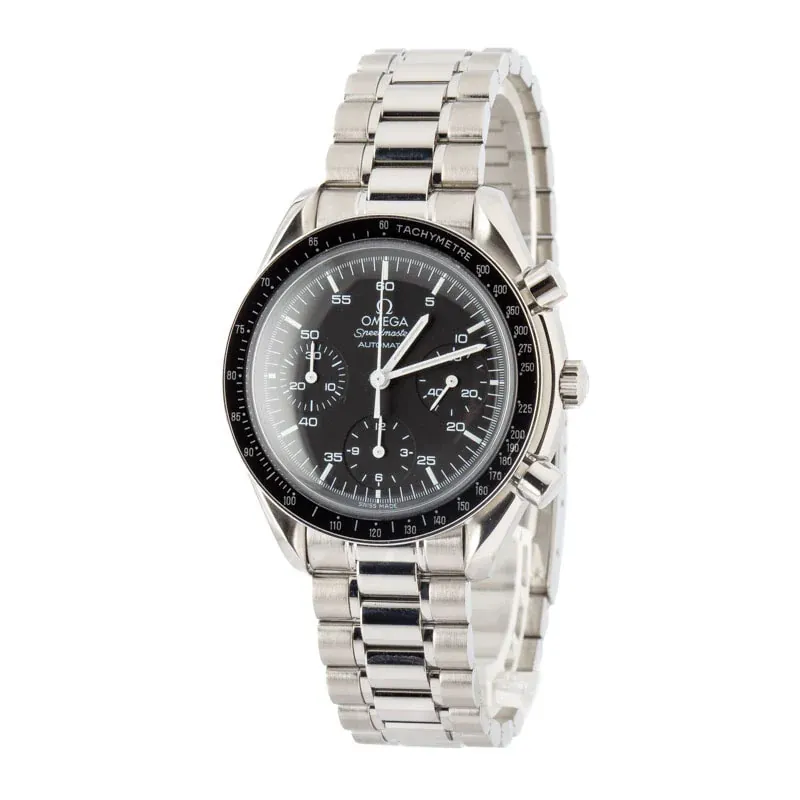
Omega makes two of the most iconic watches on earth: the Speedmaster, worn on the Moon, and the Seamaster, worn by James Bond. Both are superb — but they suit different people. Here's how to decide.
The choice is not really about which watch is better made, because they come from the same factory and hold to the same standards. It is about what kind of object you want on your wrist every day: a historical instrument with a manual ritual attached, or a modern, sealed, go-anywhere automatic. Get that question right and the rest follows.
At a glance
| Speedmaster Professional | Seamaster Diver 300M | |
|---|---|---|
| Category | Chronograph | Dive watch |
| Claim to fame | NASA flight-qualified; worn on the Moon | Modern Bond watch; genuine tool diver |
| Winding | Hand-wound on the classic Professional | Automatic |
| Bezel | Fixed tachymeter | Unidirectional dive bezel |
| Water resistance | Modest — splash-level | 300m, with helium escape valve |
| Crystal | Hesalite or sapphire, depending on reference | Sapphire |
| On the wrist | Slim, flat, vintage-tinged | Thicker, bolder, contemporary |
| Best for | History, ritual, classic looks | Everyday versatility, water use |
Heritage
The Speedmaster Professional is "the Moonwatch" — the chronograph NASA qualified for spaceflight and the watch worn on the lunar surface in 1969. Its history is unmatched among sports chronographs. The Seamaster is Omega's dive lineage, revived in the modern era as Bond's watch and a genuine tool diver with serious water resistance.
What makes the Speedmaster's story unusual is that it was not designed for space at all. It was launched as a motorsport chronograph, with a tachymeter scale on the bezel for calculating average speed, and it was only later that NASA put it through qualification testing against competing chronographs and certified it for manned missions. The watch that went to the Moon was essentially the watch that was already on sale. That is a rare thing in watchmaking, where heritage is more often retrofitted than earned.
The Seamaster name is older than most people assume and covers a wide family rather than a single watch. It began as a line of water-resistant everyday watches before the modern dive-specific interpretation took over. The Diver 300M is the reference most buyers mean today, but the Seamaster umbrella also includes the Aqua Terra, a cleaner, less overtly sporty watch that is arguably the most versatile thing Omega makes, and the Planet Ocean, which is larger and more purposeful. If the Diver 300M feels like too much watch, look sideways at the Aqua Terra before you rule out the family.
Design and wearability
The Speedmaster is a chronograph: three sub-dials, a tachymeter bezel, and a purposeful, vintage-tinged look. Its classic hesalite version wears slim and comfortable. The Seamaster Diver 300M is a modern sports watch — bolder, with a wave-pattern dial, a helium escape valve, and a more contemporary presence on the wrist.
The practical difference is thickness and profile. The Moonwatch is flat and slides under a cuff without complaint, which is part of why it works so well as a watch you wear to the office and then out. The Diver 300M is taller and has more surface, and it reads as a sports watch in every setting. Neither is heavy in absolute terms, but they sit differently, and if you have a smaller wrist the Speedmaster is generally the easier fit.
Dial legibility also splits along predictable lines. A chronograph dial is busy by nature — three registers, a running seconds hand, a central sweep hand that sits still until you start it. Some people find that visually rich; others find it cluttered. The Seamaster is the opposite: large luminous markers, high contrast, and a design brief that says tell the time instantly in bad conditions. If quick legibility matters to you, that is a genuine point in the diver's favor.
Then there is the crystal question. The traditional Moonwatch is offered with hesalite, an acrylic crystal that is period-correct, warm-looking and scratch-prone but polishable at home, or with sapphire, which is far harder but changes the look slightly. Purists tend toward hesalite. Pragmatists take the sapphire. Neither is wrong, but you should decide before you shop, because it narrows the references you are looking at.
Movement
The traditional Moonwatch uses a hand-wound chronograph movement — you wind it daily, part of its old-school charm. The modern Seamaster runs an automatic Co-Axial Master Chronometer movement with excellent anti-magnetic resistance and a long power reserve. If you want set-and-forget convenience, the Seamaster wins; if you love ritual and history, the Speedmaster delivers.
Omega's Master Chronometer certification is worth understanding because it is one of the more demanding standards in the industry. It tests the fully cased watch — not just the movement — for precision, power reserve, water resistance and resistance to strong magnetic fields. Magnetism is an underrated everyday hazard, given how many magnets we now carry in bags, laptop cases and phone stands, and Omega's approach to it is a real functional advantage rather than a marketing line. The Co-Axial escapement itself is designed to reduce sliding friction at the escapement, with the intent of extending service intervals.
Hand-winding is a genuine lifestyle decision, not a drawback to be argued away. A hand-wound watch stops if you leave it in a drawer for two days, and you set it again when you come back. Some people find that a pleasant daily ritual and a reason to feel connected to the object. Others find it an irritation by the second week. Be honest with yourself about which you are. If you want the Speedmaster look without the winding, Omega has made automatic chronographs in the Speedmaster family — but the classic Professional, the one with the history, is hand-wound. For a fuller explanation of what these differences mean mechanically, see watch movements explained.
Water resistance
The Seamaster Diver 300M is built for the water (300m). The classic Speedmaster Professional is more modest and is best kept dry beyond splashes. If you actually swim or dive with your watch, the Seamaster is the clear choice.
The gap is structural rather than incidental. A chronograph has pushers passing through the case, and the classic Moonwatch's pushers are not screw-down. A dive watch has a screw-down crown, a screw-down caseback, a unidirectional bezel that cannot be knocked to show less elapsed time than has passed, and in the Seamaster's case a helium escape valve for saturation diving. Those are the features that define the category, and we cover what they mean in practice in our dive watch buying guide. Also remember that water resistance is a condition of the gaskets, not a permanent property — on any older watch, get it pressure-tested before you swim.
Price and value
Both offer strong value in the luxury-Swiss space and hold their value well pre-owned. The Speedmaster's history gives it a devoted collector following; the Seamaster's versatility makes it an outstanding one-watch collection. Pricing between the two overlaps, so budget rarely decides it — taste does.
On the pre-owned market both are widely available, which is good news for buyers: you can be selective about condition, completeness and reference rather than taking whatever appears. Older Seamaster references in particular are among the best value propositions in Swiss watchmaking, and earlier Speedmasters offer a route into the Moonwatch story at a range of price points. Condition, originality and a full set move the needle on value more than small differences in age. Our guide to buying a pre-owned luxury watch sets out how to assess all three, and if you are shopping to a firm ceiling, best luxury watches under $5,000 is a useful reference point.
Buying either one pre-owned
A few checks apply to both. Confirm the reference number and that the dial, hands and bezel are correct for it — service replacements are common and legitimate, but they should be disclosed. On a Speedmaster, run the chronograph: the start, stop and reset should be crisp, the reset should return all hands cleanly to zero, and the sub-dial hands should sit exactly on their markers. On a Seamaster, check that the bezel rotates in one direction only, clicks without slop, and that the crown screws down smoothly rather than catching. On both, ask when the watch was last serviced and whether it has been pressure-tested since.
Authenticity is the other half of the job, and Omega is counterfeited widely enough that it matters. Our guide to spotting a fake luxury watch covers the details, but the reliable shortcut is to buy from a seller who guarantees the watch in writing. Everything we sell is covered by our Authenticity Guarantee and our 2-year warranty.
Straps, bracelets and living with them
Both watches change character considerably with a strap swap, and both are unusually good candidates for it. The Speedmaster has long been associated with leather and NATO-style straps as well as its bracelet, and its flat case and modest lug width make almost anything work. The Seamaster suits rubber and its own bracelet best; leather on a dive watch is a compromise you will regret the first time you get in the water. If you buy either pre-owned without the original bracelet, factor a replacement into your budget, because factory bracelets are expensive to source separately.
Maintenance is straightforward on both, with one asymmetry. A chronograph has more moving parts and pushers passing through the case, so it benefits from being used — running the chronograph occasionally keeps lubricants distributed — and from not being left running permanently. A dive watch asks for a rinse in fresh water after seawater and a periodic gasket check if you actually swim with it. Beyond that, both are among the more forgiving luxury watches to own. Our guide to caring for a luxury watch goes further on storage, winding and travel.
So, which one?
- Choose the Speedmaster if you love history, chronographs, and a classic look, and don't mind hand-winding.
- Choose the Seamaster if you want a modern, do-everything automatic that's happy in the water.
If you still cannot separate them, ask what else is in your collection or what else you are likely to buy next. The Speedmaster pairs beautifully with a diver from another brand; the Seamaster pairs well with a dress watch or a chronograph. Buying the one that fills a gap rather than duplicating what you already own is the most reliable tiebreaker there is. It is also worth comparing against the obvious rivals before you commit — a Rolex Submariner, a Tudor Black Bay or a Breitling chronograph all overlap with one side or the other of this decision.
Either way, you're buying one of the great watches. Browse our certified Omega collection — every piece is authenticated, inspected, and backed by our 2-year warranty. If you would like help tracking down a particular reference, get in touch.