
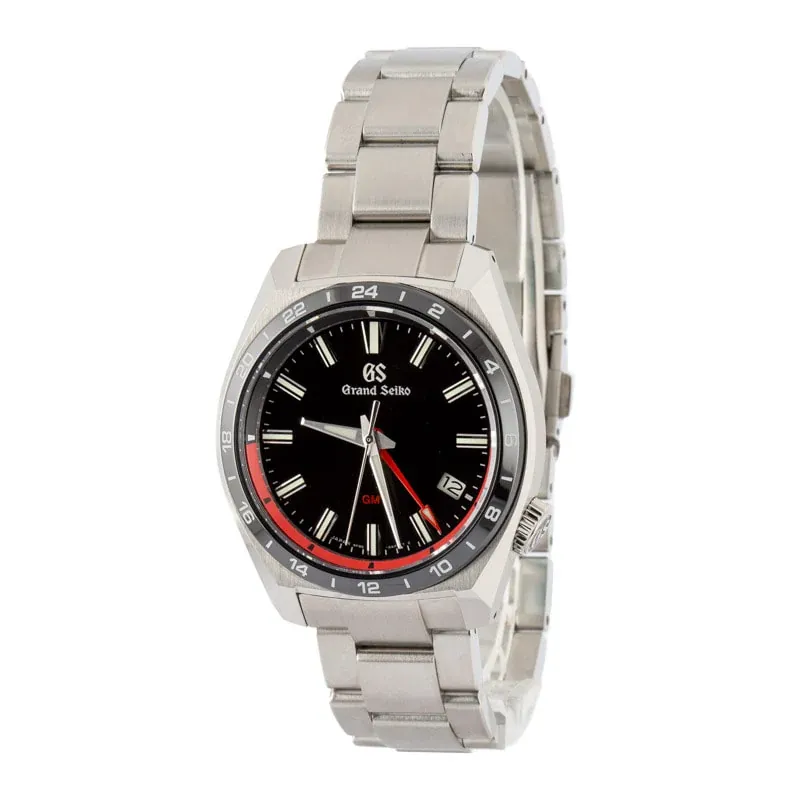
The movement is the engine of a watch — and the type of movement shapes how it feels, how you care for it, and what it costs. Two watches can look almost identical on the wrist and behave completely differently because of what is happening under the dial. Here's a clear guide to the four movement types you'll encounter, how each one works, and how to read the specifications brands quote.
How a mechanical watch keeps time
Before comparing types, it helps to understand the basic machine. Every mechanical watch does four things in sequence.
- Stores energy. A coiled ribbon of hardened steel called the mainspring sits inside a barrel. Winding the watch tightens that ribbon.
- Transmits energy. As the mainspring unwinds it drives a train of toothed wheels, geared so that one turns once an hour, another once a minute. Those wheels carry the hands.
- Releases energy in tiny, equal portions. Left alone the gear train would spin until the mainspring ran flat in seconds. The escapement locks and unlocks it hundreds of times a minute, letting it advance one small step at a time. That is the ticking you hear.
- Regulates the rate. The escapement is controlled by the balance wheel, a small weighted wheel on a fine coiled hairspring that swings back and forth at a fixed frequency. Change the effective length of the hairspring and you change the rate of the whole watch.
That is the entire principle, and it has barely changed in two hundred years. Everything else — automatic winding, chronographs, calendars — is built on top of it. Our guide to watch complications covers how those extra functions are layered on.
Automatic (self-winding mechanical)
The most common movement in modern luxury watches. A rotor spins as you move your wrist, winding the mainspring automatically. No battery, a smooth sweeping seconds hand, and — kept wound — it runs indefinitely. Automatics are the heart of most Rolex, Omega, and Tudor watches. They need a service every 5–10 years and will stop if left unworn for a day or two (a watch winder keeps them running).
The rotor is a weighted semicircle on a central pivot. Because it is off-center, gravity keeps it hanging downward while your arm moves around it, so ordinary daily motion turns it constantly. That rotation is geared down and fed into the mainspring barrel. Better calibers wind in both directions of rotor travel; simpler ones wind in one direction only and are slightly less efficient.
Two details separate a good automatic from an adequate one. The first is the slipping bridle — a clutch inside the barrel that lets the mainspring slip once fully wound, which is why you cannot overwind an automatic by wearing it. The second is hand-winding capability. Most, though not all, automatics can also be wound from the crown. If a watch has been sitting, thirty turns of the crown gets it running properly rather than starting it on a nearly flat mainspring, where accuracy suffers. The trade-off with any automatic is thickness: the rotor adds height, which is why the slimmest dress watches are usually hand-wound.
Manual (hand-wound mechanical)
The oldest type: you wind the crown by hand, typically daily. Manual movements let designers build very thin cases and are prized for their mechanical purity and connection to the watch. The classic Omega Speedmaster Moonwatch is hand-wound. The trade-off is the daily ritual — which enthusiasts consider a feature, not a chore.
Technique matters more here than most people realize. Wind at a steady, unhurried pace and stop when you feel firm resistance — a manual movement has no slipping clutch, so it genuinely can be overwound if you force past the stop. It is also good practice to wind the watch off the wrist, since winding it in place puts a sideways load on the stem that wears the keyless works over years.
With no rotor obscuring the view, hand-wound calibers are also the ones most often shown off through a display caseback. Many dress watches use them for exactly that reason.
Quartz
Powered by a battery and regulated by a vibrating quartz crystal, quartz movements are extremely accurate, low-maintenance, and affordable. The seconds hand ticks once per second. They're perfect for a grab-and-go watch, and brands like Tissot and Seiko make excellent quartz pieces. The battery lasts years and is inexpensive to replace.
The mechanism is elegantly simple. A tiny bar of quartz, usually cut into a tuning-fork shape, is made to vibrate by current from the battery. Quartz is piezoelectric, so it also generates a voltage as it flexes, letting the circuit lock onto its natural frequency — standardized at 32,768 vibrations per second. An integrated circuit halves that frequency repeatedly until it produces one pulse per second, and that pulse drives a small stepper motor which advances the gear train one step. Hence the tick.
A quartz crystal's frequency drifts slightly with temperature, which is the main limit on ordinary quartz accuracy. High-end calibers solve this with thermocompensation: a sensor measures the temperature and the circuit adds or removes pulses to correct the drift, holding accuracy to a few seconds a year rather than a few seconds a month. The one practical caution with any quartz watch is to replace a dead battery promptly rather than leaving it in the case, where it can eventually leak.
Spring Drive
Grand Seiko's Spring Drive is a fascinating hybrid: it's powered by a mechanical mainspring like an automatic, but regulated electronically for quartz-like accuracy. The result is a uniquely smooth, perfectly gliding seconds hand — no ticking at all — and exceptional precision. It's one of watchmaking's most impressive technical achievements.
What makes it unusual is that it has no escapement and no balance wheel. Instead the mainspring drives a rotating component called the glide wheel, which generates a small electrical current as it spins — enough to run a quartz oscillator and an integrated circuit. That circuit compares the glide wheel's actual speed to the quartz reference and applies an electromagnetic brake whenever it runs fast. Grand Seiko calls the arrangement the Tri-synchro Regulator, because it manages mechanical, electrical and magnetic energy together. There is no battery and no stepper motor, so nothing makes the hands jump.
Movement types at a glance
| Movement | Power source | Seconds hand | Routine upkeep | Best for |
|---|---|---|---|---|
| Automatic | Mainspring wound by a rotor | Sweeping, in small steps | Service every 5–10 years | An everyday luxury watch worn regularly |
| Manual | Mainspring wound by hand | Sweeping, in small steps | Daily winding; service every 5–10 years | Thin dress watches and purists |
| Quartz | Battery | One tick per second | New battery every few years | Travel, occasional wear, low fuss |
| Spring Drive | Mainspring, electronically regulated | Perfectly continuous glide | Specialist service on mechanical intervals | Connoisseurs wanting both worlds |
Accuracy: what the numbers mean
Mechanical accuracy is quoted as a daily rate — how many seconds fast or slow the watch runs in twenty-four hours. A modern automatic that gains a few seconds a day is behaving normally, and a consistent gain is far better news than an erratic one. Consistency is what a watchmaker can adjust; erratic behavior usually points to a fault.
Several certifications formalize this. COSC, the Swiss official chronometer testing institute, tests loose movements over fifteen days in five positions and at three temperatures, and requires an average daily rate between −4 and +6 seconds. Movements that pass earn the word "chronometer" on the dial. METAS Master Chronometer certification, used by Omega, tests the fully cased watch after COSC and requires 0 to +5 seconds per day, alongside resistance to magnetic fields of 15,000 gauss. Rolex applies its own Superlative Chronometer standard to cased watches, tightening the tolerance to −2/+2 seconds per day.
Why your watch's rate changes
Position is the biggest everyday factor. Gravity affects the balance differently dial-up on a nightstand than crown-down in a drawer, and the gap between positions can be several seconds a day. If your watch runs fast, try resting it overnight in whichever position slows it — many owners effectively regulate their watch this way without ever opening it. Power reserve matters too: a movement running on the last hours of its mainspring usually loses accuracy. Temperature and magnetism are the other variables, and magnetism can cost minutes rather than seconds. Our watch care guide covers demagnetizing and the sources to avoid.
In-house versus supplied movements
Not every brand makes its own calibers, and that is not the failing it is sometimes made out to be. Much of the Swiss industry has long been built on movements from specialist suppliers — ETA and Sellita best known — which brands then finish, regulate and modify. The ETA 2824 and its Sellita equivalent, and the Valjoux 7750 chronograph, are among the best understood mechanisms in watchmaking. Almost any competent watchmaker can service them and parts are readily available, which is a genuine long-term advantage.
In-house calibers let a brand control the specification: longer power reserves, proprietary hairspring alloys, distinctive layouts and finishing. Tudor's move to in-house movements with roughly seventy hours of reserve and chronometer certification is a good example. The trade-off is that parts and service expertise are often restricted to the brand's own network.
The takeaway for a buyer: judge the watch, not the label. A well-executed supplied caliber in a well-built case from Longines, Oris or Hamilton can be a more sensible ownership proposition than an exotic in-house movement with a difficult service story.
Power reserve and winding habits
Power reserve is how long a fully wound movement runs unattended. Classic calibers sit around forty hours; many modern designs stretch to sixty or seventy, often using a larger barrel or twin barrels. The threshold most people care about is the weekend: roughly seventy hours means a watch taken off on Friday evening is still running Monday morning. Wind an automatic fully before a day of desk work, which barely moves the rotor, and when a watch has stopped completely, wind it before setting the time so the calendar work is driven with proper force.
Reading a movement's spec sheet
Four numbers do most of the work when you compare calibers.
- Frequency, in vibrations per hour (vph) or hertz. 28,800 vph (4 Hz) is the modern standard; 21,600 vph (3 Hz) is common in longer-reserve and vintage-style calibers; 36,000 vph (5 Hz) allows finer timing but demands more of the lubricants. Higher is not automatically better.
- Jewels — synthetic ruby bearings that reduce friction at the pivots. A very high count usually reflects added complications rather than superior quality.
- Power reserve, discussed above.
- Caliber number, which tells you what is really inside and lets you research parts availability and likely service costs before you buy.
If you are shopping pre-owned, confirming the caliber against the reference number is also a useful authenticity check. Our guide to buying pre-owned goes into the details.
Which should you choose?
- Automatic — the classic choice for a luxury watch you'll wear regularly. Mechanical soul, no battery.
- Manual — for enthusiasts who love the ritual and want the thinnest, most traditional pieces.
- Quartz — for accuracy, low maintenance, and a hassle-free everyday or travel watch.
- Spring Drive — for the connoisseur who wants mechanical heart with near-perfect accuracy and that mesmerizing gliding hand.
If this is your first serious watch, an automatic from an established maker is the safe and satisfying answer — the type is well understood, servicing is straightforward, and resale demand is strongest. Plenty of the best options sit below the price people expect.
Caring for your movement
Mechanical watches (automatic and manual) benefit from a professional service every several years to keep them accurate and protected. Quartz simply needs a battery when it stops. Whatever you choose, buy a watch that's been properly inspected — every piece we sell is checked to confirm it's keeping good time before it ships, and covered by our 2-year warranty. Explore the collection to find your movement of choice, or browse by brand.