
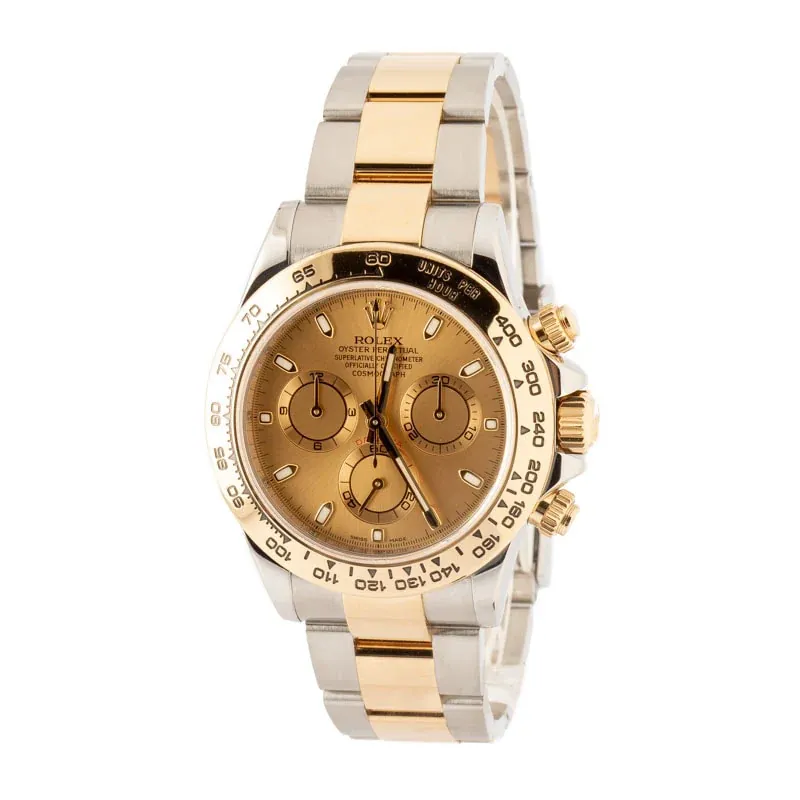
Counterfeit watches have improved dramatically — the best "super clones" fool casual buyers and even some jewellers. The good news: genuine watches are built to standards that fakes still struggle to match. Here are the ten checks our specialists use. Treat them as a whole, not a single pass/fail — authenticity is a weight of evidence.
That last point is the one most people get wrong. No single detail proves a watch genuine. Counterfeiters study the same lists of tells that buyers do, and any individual flaw they hear about repeatedly is the one they fix first. What they cannot fix economically is the accumulated cost of getting everything right at once — the movement, the finishing, the tolerances, the materials and the machining, all to the same standard. Authentication is the practice of checking enough of those things that the odds of a convincing forgery collapse.
Why counterfeits got so good
Two things changed. Manufacturing tolerances that once required a Swiss factory are now available to anyone with capital, and high-resolution photography of genuine watches is freely available for study. The result is a tier of replica that gets the silhouette, the dial layout and even the case proportions close enough that a photograph is no longer evidence of anything.
What has not changed is the economics. A replica has to be built to a price, and the money goes where buyers look — the dial, the bezel, the bracelet. It does not go into the parts nobody photographs. That is why the checks below weight movement, machining and materials so heavily.
1. Weight and feel
Luxury watches use solid stainless steel, gold, titanium, or platinum, and they feel dense and substantial. Many fakes use lighter alloys and feel hollow or "toy-like." Learn the correct weight for the reference you're buying.
Weight distribution matters as much as total mass. On a genuine watch with a solid-link bracelet, the weight is spread across the whole piece rather than concentrated in the head, and the bracelet drapes rather than hangs stiffly. Hollow end-links and stamped clasps announce themselves the moment you pick the watch up. Gold is the easiest metal to judge by hand: it is noticeably heavier than steel.
2. The movement
This is the single most revealing check. Genuine mechanical movements are beautifully finished and run with a smooth sweeping seconds hand (roughly 6–8 ticks per second). A quartz-style once-a-second "tick" on a watch that should be automatic is an instant red flag. Where possible, a specialist opens the caseback to inspect the movement's finishing, engravings, and architecture.
Inside, look at the layout of the bridges, the quality of the perlage and côtes de Genève decoration, the finishing on screw heads and jewel settings, and whether any engraved caliber markings are crisp. Replicas frequently use a generic base movement dressed up to resemble the correct caliber, which shows immediately in the position of the balance wheel and the shape of the winding rotor. If you cannot open the case yourself, a watchmaker will do it in minutes. Our guide to watch movements explained covers what a correct movement should look like for each of the major types.
3. Dial printing and text
Under magnification, genuine dial text is razor-sharp, perfectly aligned, and evenly spaced. Fakes often show fuzzy, uneven, or slightly misaligned printing. Check the logo, model name, and any depth-rating text closely.
Applied elements deserve the same attention. Applied indices and logos on a genuine dial are seated flat and secured precisely; on replicas they are frequently glued and can sit fractionally proud or slightly crooked. Check that the minute track aligns exactly with the hour markers all the way around the dial, and that printed text does not thicken or bleed at the edges of the letters.
4. Date window and cyclops magnification
On watches with a magnifying "cyclops" lens (like a Rolex Datejust), the genuine lens magnifies the date roughly 2.5x and fills the window. Weak or off-center magnification is a common tell. The date should also be perfectly centred in the aperture.
Look at the date disc itself as well. The font, the color of the numerals and the depth of the print should match the reference exactly. The date should also change crisply at midnight on watches designed to do so, rather than crawling over half an hour. A slow, dragging changeover on a reference known for an instantaneous jump is a meaningful warning.
5. Serial and reference numbers
Genuine engravings are crisp, precise, and consistent. Older sand-blasted or newer laser-etched serials each have a characteristic look. Numbers that are shallow, uneven, or "dotty" under a loupe suggest a counterfeit. The reference number should also match the watch's actual configuration.
Consistency across the watch matters too. Serial numbers appear in different places depending on the brand and the era — between the lugs, on the rehaut, on the case back or on the movement — and they should agree with each other and with any paperwork. A serial that has been polished shallow, partially erased or re-struck is a serious problem even on an otherwise genuine watch: it usually means the case has been replaced or the history is being hidden.
6. The crystal and anti-reflective coating
Most modern luxury watches use scratch-resistant sapphire crystal. A genuine sapphire is very hard and often has a subtle anti-reflective tint. Some fakes use mineral glass that scratches easily and reflects differently.
A simple, non-destructive test: breathe on the crystal. Sapphire conducts heat well and clears condensation quickly compared with mineral glass, which fogs and stays fogged for noticeably longer. Anti-reflective coating, where the reference has it, produces a faint blue or purple cast at an angle rather than a plain mirror-like reflection.
7. The bezel and its action
On dive watches, the unidirectional bezel should turn with firm, precise clicks and no wobble. A loose, gritty, or bidirectional bezel where it should be unidirectional is a warning sign.
Count the clicks. Most modern dive bezels index in 120 positions, giving half a minute per click, and each one should land exactly on a marker with no back-play. Ceramic bezel inserts on genuine watches have deeply and evenly filled markings and a uniform surface color. If you are shopping this category specifically, our dive watch buying guide explains what the bezel and the depth rating actually mean.
8. Bracelet, clasp and end-links
Genuine bracelets are solid, with tight tolerances and a clasp that engages with a satisfying, well-machined action. Engravings on the clasp are clean. Rattly links, sharp edges, and flimsy clasps point to a fake.
Run the bracelet through your fingers. On a genuine watch the link edges are chamfered and smooth; on a copy they catch. End-links should meet the case with a consistent hairline gap and no rocking, and any micro-adjustment or extension system should operate without force. The clasp is one of the most expensive parts of a bracelet to make correctly, which is exactly why it is one of the most reliable places to look.
9. Lume and hands
The luminous material on hands and markers should be applied evenly and glow strongly and consistently after light exposure. Patchy, weak, or unevenly colored lume is a common shortcut on counterfeits.
Charge the watch under a bright light for thirty seconds and then look at it in the dark. Every marker and hand should light at the same intensity and in the same color, and the glow should persist for hours rather than fading within minutes. Mismatched color between the hands and the dial markers usually means either a replacement part or a counterfeit.
10. Papers — and where you're buying
Original papers help, but they can be faked too, so never rely on them alone. The most reliable safeguard is who you buy from. A specialist who inspects every watch and guarantees authenticity in writing removes the guesswork entirely.
Where papers do add value is in cross-referencing. The serial number, reference and date on the card should match the watch and each other, and any service records should be consistent with the watch's apparent condition. Details that contradict the watch itself deserve scrutiny, not reassurance.
Genuine versus counterfeit at a glance
| What you check | Genuine | Typical counterfeit |
|---|---|---|
| Seconds hand | Smooth sweep, lands precisely on the markers | Stutters, or ticks once per second |
| Movement finishing | Decorated bridges, crisp engraving, correct architecture | Generic base caliber, coarse or absent decoration |
| Dial text | Sharp edges, perfect alignment, even spacing | Soft or bleeding print, slight misalignment |
| Case machining | Crisp bevels, consistent brushing and polishing | Rounded edges, uneven grain, visible tool marks |
| Bracelet and clasp | Solid links, tight tolerances, clean action | Rattle, sharp edges, loose end-links |
| Lume | Even, strong, long-lasting, matched color | Patchy, weak, mismatched between hands and dial |
Tools worth owning
You do not need a workshop. Four inexpensive items cover most of what a buyer can check without opening a case:
- A 10x loupe. Almost every printing and engraving tell becomes obvious under magnification.
- A digital scale. Catches wrong materials and hollow construction in seconds.
- A bright light source. For charging lume and raking light across the case.
- A phone timing app. Enough to hear whether a movement beats evenly.
Frankens, redials and service parts
Not every problem watch is a fake. A "franken" is a genuine watch assembled from the parts of several others, and a redial is a genuine watch whose dial has been repainted, often to hide damage. Both are common in vintage, and both are worth far less than an honest original — sometimes dramatically so. The tells are subtle: a font that is a shade off period, hands that do not match the dial's lume color, a bezel insert in fresher condition than everything around it, or a case back serial that does not agree with the movement.
Replacement parts fitted during a legitimate service sit somewhere in between. A factory-supplied replacement hand or crystal does not make a watch inauthentic, but it does affect value on collectible references, and it should be disclosed. Ask what has been replaced and when.
Red flags in the listing, not the watch
Long before you get a loupe on anything, the way a watch is sold tells you a great deal:
- A price well below the going rate. The market is transparent enough that genuine bargains at large discounts effectively do not exist.
- Stock or borrowed photographs. A real seller can photograph the actual watch from every angle, including the clasp and the case back.
- Vague answers about condition or history. "Runs great" is not a service record.
- Pressure and urgency. Manufactured deadlines exist to stop you from checking.
- Irreversible payment methods only. Any refusal of a traceable, protected payment route should end the conversation.
- No returns and no warranty. A seller confident in a watch has no reason to refuse either.
What to do if you think you've bought a fake
Act quickly and in order. Stop wearing the watch and keep the packaging, the listing and every message from the seller. Get a written opinion from an independent watchmaker or the brand's service center — a verbal opinion is worth little if you need to escalate. Contact the seller in writing and state plainly what you found. If the sale went through a payment provider or a marketplace, open a dispute inside the stated window, because those windows are short and rarely extended. And do not attempt to resell it — passing on a counterfeit exposes you to real legal risk.
The better outcome is not needing any of that. Buying through a seller with a written Authenticity Guarantee, a warranty and a clear return policy converts an authentication problem into a customer service one.
The safest check of all
Even experts use magnification, reference data, and movement inspection — you shouldn't have to authenticate a five-figure purchase by eye. Every watch at WatchDealHub.com is inspected by our specialists, certified 100% authentic, and covered by a money-back Authenticity Guarantee. Browse with confidence across all our brands, or start with the Rolex collection.
Counterfeiters concentrate their effort where demand is highest, which means the most-copied watches are the most famous ones — the Rolex Submariner and Daytona, the Omega Speedmaster and Seamaster, the Audemars Piguet Royal Oak and the Patek Philippe Nautilus. Less-copied but excellent alternatives from Tudor, Longines and Grand Seiko carry meaningfully less counterfeit risk. If you want the wider context on buying safely, read how to buy a pre-owned luxury watch, and when you are ready, browse the certified collection.