
Water resistance is the most misread specification in watchmaking. The number printed on a dial or engraved on a caseback looks like a depth — 30 meters, 100 meters, 300 meters — and almost everyone reads it as a promise about how far down the watch can go. It is not that, and the gap between the two readings has ruined a great many movements.
This guide sets out what the rating actually measures, why a watch marked 30m has no business in a pool, how pressure behaves differently on a moving wrist than in a laboratory, and what the sealing parts of a watch do. It ends with the practical question: which watches in our catalog suit which activities.
What the number on the caseback actually measures
A water resistance rating is the result of a pressure test, not a depth trial. The watch is placed in a chamber, subjected to a pressure equivalent to a column of water of the stated height, held there for a set period, and then checked for ingress. Pressure and depth are linked by simple physics — roughly one bar for every ten meters of water — which is why the two units appear interchangeably on dials. A watch marked 10 bar and a watch marked 100m make the same claim.
Three details matter enormously and are never stated on the dial. First, the test is performed on a new watch with gaskets that have never been compressed, heated or aged. Second, on ordinary water-resistant watches it is often carried out on samples from a batch rather than on every piece. Third, and most importantly, the pressure applied is static — steady, uniform and unchanging. Almost nothing you do with a watch in real water is static.
The rating is a ceiling measured under ideal laboratory conditions on the day the watch was made, not a working allowance. Leave a wide margin beneath it.
The ratings, translated into activities
Here is the conventional reading of each rating, deliberately conservative because the consequences of getting it wrong are expensive.
| Marking | Equivalent | Reasonable use | Do not |
|---|---|---|---|
| 30m | 3 bar | Rain, handwashing, an accidental splash | Swim, shower, or submerge at all |
| 50m | 5 bar | As above, plus brief shallow immersion | Swim laps, dive, or use in hot water |
| 100m | 10 bar | Swimming, poolside, light snorkeling | Scuba dive or press pushers underwater |
| 200m | 20 bar | Swimming, snorkeling, most recreational diving | Assume it is fine without recent testing |
| 300m and above | 30 bar and above | Scuba diving and any water activity | Neglect gasket servicing |
Why 30m is not a swimming watch
A 30m rating exists to protect the movement from the ordinary hazards of daily life: rain, washing your hands, a spilled drink. It is a splash rating. Deliberate immersion, even in a shallow pool, introduces pressure spikes, temperature changes and prolonged contact with water that the case was never designed to shrug off. Most dress watches sit at this level, and many owners have learned the hard way that a rating sounding like three times their own height is nothing of the sort.
The same reasoning applies at 50m, only slightly less severely. If swimming is part of your routine, 100m is the practical starting point and 200m the comfortable one.
Static pressure versus what actually happens in water
The laboratory applies pressure evenly and holds it. Real water does not behave so politely. Swinging an arm through water, diving into a pool, catching the jet from a shower head, or the sudden push of a wave against the crown all create brief pressure spikes considerably higher than the depth alone suggests. These are dynamic loads, concentrated on precisely the weakest points of the seal.
Temperature is the second problem, and the one that catches out the most otherwise careful owners. A hot shower, a sauna or a plunge from warm air into cold water makes metal and rubber expand at different rates, so the case and its gaskets move against each other and briefly open a path that does not exist at a stable temperature. Steam is worse still: water vapor finds its way past seals that liquid water would not trouble, and once inside it condenses on the underside of the crystal.
Soap and chemicals complete the picture. Detergents lower the surface tension of water, helping it creep into gaps, and the oils and solvents in soaps and sunscreens attack the rubber compounds gaskets are made from. None of this is dramatic on any single occasion — the damage is cumulative.
How a watch actually keeps water out
A case has four places where water can get in, and each is sealed differently.
- The crystal — pressed or sealed into the case, usually against a gasket. A chipped or cracked crystal is a breach even if the watch still runs perfectly.
- The caseback — screwed down or pressed on over a gasket. This is the seal most often disturbed, because it is the one opened for servicing or a battery change.
- The crown and its tube — the hardest point to seal, because the stem must move and rotate through the case wall.
- Pushers, on chronographs, which have the same problem as the crown and multiply it by two.
Screw-down crowns
A screw-down crown threads onto a tube and compresses its gaskets against it, which is why it is standard on anything intended for real immersion. It also introduces the single most common cause of water damage in the hobby: the owner who unscrews the crown to set the time and forgets to screw it back down. Nothing about the watch's appearance changes, and the failure is discovered days later as fog under the crystal. Make screwing the crown back down a reflex.
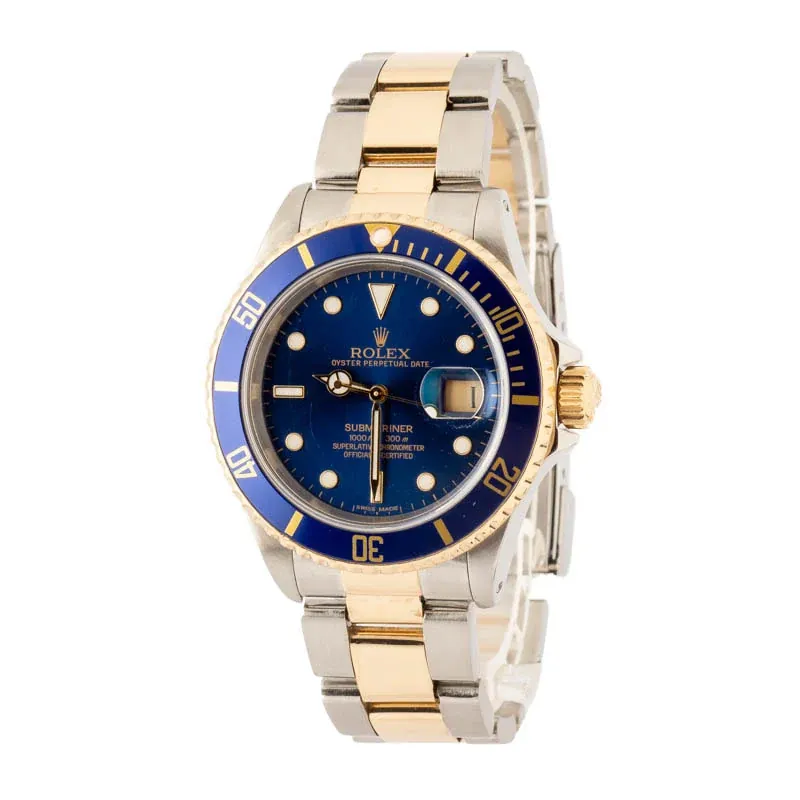
Manufacturers layer this system to different degrees. Rolex, for example, uses Twinlock crowns on most models and the more heavily sealed Triplock system on its divers. Whatever the branding, the rule is the same: an unscrewed crown means the watch has no meaningful water resistance at all.
Pushers, bezels and helium valves
Chronograph pushers should never be operated underwater unless the watch is specifically designed for it — most are not, and pressing a pusher against water pressure is an invitation to let water past the seal. Screw-locked pushers exist on some dive chronographs for exactly this reason. Our guide to watch complications covers what those extra buttons do in the first place.
A rotating bezel plays no part in sealing the case; it sits outside the gaskets entirely. And the helium escape valve on some deep divers is widely misunderstood: it is not there to keep water out but to let helium escape during decompression after saturation diving, which almost no owner will ever do. It is a specialist feature, not a measure of how waterproof a watch is.
"Water resistant" versus a true diver's watch
There are two different standards in play. General water-resistant watches are tested to ISO 22810. Watches described as diver's watches are built and tested to the much stricter ISO 6425, and only those may carry the word DIVER'S alongside the depth marking — the word on the dial is a certification, not an adjective.
The differences are substantial. Under ISO 6425 every watch is tested rather than a sample from the batch, and it is tested at 125 percent of its rated pressure. The watch must resist condensation, magnetism, shock and salt water, carry a unidirectional bezel with a sixty-minute scale, stay readable in total darkness at 25 centimeters, and have a strap attachment strong enough to be relied on. A 200m watch without diver's certification and a 200m watch with it are not the same proposition. Our dive watch buying guide covers what separates a real diver from a watch that merely looks like one.
Gaskets age, and so does water resistance
This is the point that changes how you should think about owning a water-resistant watch. Gaskets are rubber or similar synthetic compounds. They are compressed permanently from the day the case is closed, and they harden, shrink and lose elasticity with heat, ultraviolet light, chemical exposure and simple age. A watch rated 300m when it left the factory two decades ago is not a 300m watch today unless someone has replaced those gaskets and tested it since.
The remedy is straightforward. A watchmaker can pressure test a watch in minutes — a dry test measures case deformation under pressure, a wet test looks for escaping air bubbles. Have it done before a holiday, after any service, after a battery change, and periodically if you swim with the watch. A full service replaces every gasket and retests the case. Our watch care guide covers the wider maintenance picture, and watch movements explained is worth reading if you want to understand what the water is threatening.
Vintage watches deserve their own category. Assume a vintage piece has no water resistance whatsoever until proven otherwise: cases from earlier eras were sealed with materials that have long since aged out, crystals may have been replaced with parts that do not seal correctly, and original casebacks are often worth preserving rather than resealing. Enjoy a vintage watch dry.
Matching the rating to what you actually do
Our stock spans 650 watches across 40 brands, and the sensible way to shop is to decide what the watch will be exposed to before you fall for a dial.
Dress and daily watches: keep them dry
Slim dress watches trade sealing for elegance, which is a reasonable trade as long as you respect it. The Omega De Ville Prestige and De Ville Tresor pieces in stock, the Longines Flagship and Mini DolceVita, and the Hamilton Ventura and Jazzmaster are watches to take off before the shower, not watches to swim in. Current Omega stock runs from about $1,000 to just under $30,000, and Hamilton from around $445 to $2,645.
Everyday all-rounders
If you want one watch that handles a swim without ceremony, this is the category. The Omega Seamaster Aqua Terra 150M is the archetype — a watch that reads as dressy but carries a genuine 150m case. From Longines, the Conquest, Spirit and Spirit Zulu Time lines are built for real use, with current Longines stock from about $395 to $5,550. The Hamilton Khaki Field and Khaki Field Titanium are rugged, but field watches as a category are rated for weather rather than swimming, so check the individual reference.
Watches built for water
For anything beyond swimming, buy a certified diver. Rolex Submariner references dominate our Rolex stock — from the 16610 and 16613 through the 114060, the 116610LV Hulk and the 126610LV Starbucks — and current Rolex stock runs from about $2,895 to $120,995. From Omega, the Seamaster Planet Ocean 600M and the Seamaster Diver 300M are the purpose-built choices. Longines covers the category at a friendlier level with the HydroConquest, the Legend Diver and the Heritage Skin Diver. Brands such as Oris and Tissot are worth a look in the same vein.
How watches actually get flooded
In practice, catastrophic water damage almost never comes from exceeding a depth rating. It comes from a short list of ordinary mistakes: a crown left unscrewed; a hot shower or a sauna; a chronograph pusher pressed while the watch was wet; a crystal chipped in an impact that seemed trivial at the time; or a caseback closed after a battery change without a fresh gasket. Every one of these is avoidable, and none requires going anywhere near the rated depth.
If you do find moisture or fog inside a watch, treat it as urgent. Water in a movement causes corrosion that becomes expensive fast, and a day's delay can be the difference between a service and a replacement part.
Buying a water-resistant watch pre-owned
Ask direct questions. Has the case been pressure tested, and when? Have the gaskets been replaced at the last service? Does the crown thread down smoothly, without grit? Is there any haze or spotting on the dial that might indicate past moisture? Aftermarket parts are a particular concern, because a replacement crystal, caseback or crown not made for the reference can compromise the seal while looking entirely correct.
Every watch we sell is inspected and guaranteed authentic, with free insured US shipping, a 14-day return window and a 2-year movement warranty — the details are in our Authenticity Guarantee and warranty terms. If you are new to the secondary market generally, how to buy a pre-owned luxury watch walks through the whole process.
The summary is simple enough to carry in your head: the number is a laboratory ceiling, not a permission slip; screw the crown down every time; keep the watch out of hot water; and have the seals checked rather than assumed. Browse the full collection or get in touch if you want help matching a rating to how you live.