
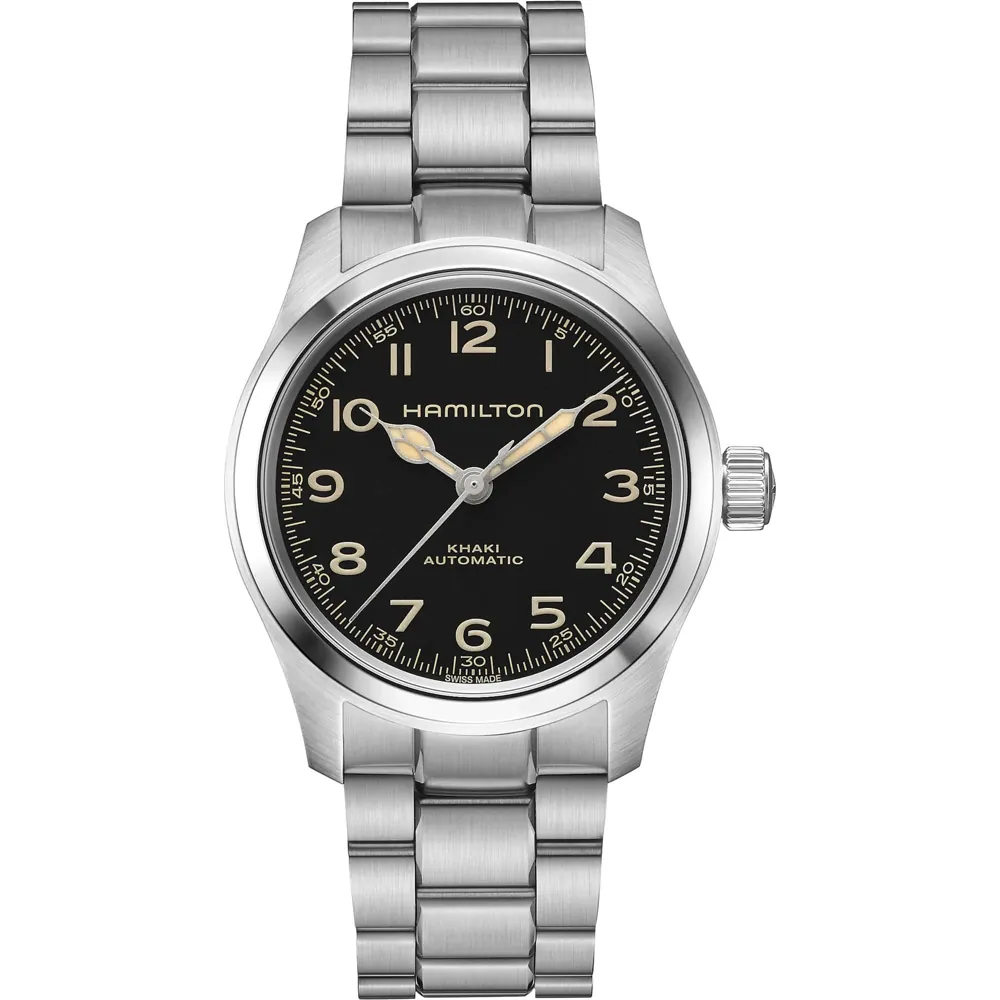
The most common reason a good watch goes unworn is not the movement, the brand or the dial color. It is fit. A case that overhangs the wrist, rides high under a cuff or slides around on a loose bracelet stops being something you reach for, however well it photographed.
Sizing is also the thing online listings explain worst. One number in millimeters gets quoted, every buyer anchors to it, and the two measurements that actually govern how a watch wears go unmentioned. This guide covers what to measure, what to ignore, and how to judge fit from a listing when you cannot try the watch on first.
The three numbers that describe a case
A watch case has three dimensions worth knowing, and they do different jobs. Most buyers know the first, some know the second, and almost nobody weighs the third until they own the watch and find it catching on shirt cuffs.
Case diameter
Diameter is the width of the case measured across the middle, usually excluding the crown. It is the number brands print and sellers quote — the Hamilton Khaki Field Murph is sold as a 38mm watch, the Longines Conquest in black PVD as a 41mm, the Omega Speedmaster Moonwatch Professional as a 42mm. Diameter tells you roughly how much dial you get and how much visual presence the watch has.
What it does not tell you is whether the watch will fit. Two cases of identical diameter can wear entirely differently depending on how much bezel surrounds the dial, how far the lugs extend and how the case sides are shaped. A dive watch with a thick rotating bezel looks smaller on the wrist than a dress watch of the same diameter with a slim bezel and an expansive dial. Diameter is a starting point and nothing more.
Lug-to-lug
Lug-to-lug is the length of the case from the tip of the top lugs to the tip of the bottom lugs — the full vertical footprint. This is the measurement that decides whether a watch fits, because it determines whether the case sits within the flat top of your wrist or hangs over the edges.
When lug-to-lug exceeds the flat area of your wrist, the lug tips lift off the skin, the strap has to bend sharply to reach around, and the watch rocks. No amount of strap adjustment fixes it. This is why a 42mm case with short, steeply curved lugs can be comfortable on a small wrist while a 38mm case with long, flat lugs is not. If you take one number away from this article, take this one.
Thickness
Thickness governs how the watch lives on you rather than how it looks in a photograph. A thick case raises the center of gravity, makes the watch more likely to catch a cuff or a doorframe, and makes it top-heavy on a strap. Dive watches are thicker because of the case construction and the depth rating — the trade-off that our dive watch buying guide covers in more detail.
Thickness also interacts with diameter in a way that surprises people. A small, thick watch often wears worse than a large, thin one, because the slab-sided proportions read as bulky rather than substantial. If you wear long sleeves most days, treat thickness as roughly equal in importance to lug-to-lug.
Measuring your wrist properly
Two measurements are worth taking, and a flexible tailor's tape or a strip of paper and a ruler will do both.
The first is circumference: wrap the tape around your wrist just past the wrist bone, where the watch will actually sit, snug but not tight. This number sizes the bracelet or strap.
The second — the one most people skip — is the flat width across the top of your wrist. Rest your forearm palm-down on a table and measure across the top surface, from where it starts to curve down on one side to where it curves down on the other. That distance is your practical ceiling for lug-to-lug. A watch whose lug-to-lug comfortably fits inside it will sit flat and stable.
Wrist shape matters as much as size. Flat, wide wrists carry long cases well even at modest circumference. Round wrists have less usable flat surface at the same circumference, so the ceiling is lower than the tape measure suggests. Measure both, and trust the flat width.
A starting point, not a rule
The table below is a reasonable place to begin if you have never worn a mechanical watch. Treat it as a first guess to be overruled by what actually looks right on you — plenty of people happily wear cases well outside their row.
| Wrist circumference | Typical comfortable diameter | Watch the lug-to-lug |
|---|---|---|
| Under 6 inches | Mid-thirties millimeters | Long-lugged cases will overhang |
| 6 to 6.75 inches | Mid-thirties to around 40mm | Curved lugs buy you a few extra millimeters |
| 6.75 to 7.5 inches | Around 38mm to low forties | Most sports watches fit comfortably |
| Over 7.5 inches | Low forties upward | Thickness matters more than length here |
Why lug-to-lug beats diameter every time
Consider two watches with very similar diameters. The Hamilton Khaki Field Murph at 38mm has a compact case with lugs that turn down early, so it sits within the wrist on almost anyone. A vintage-influenced dress watch of the same diameter with long, straight lugs will reach noticeably further and demand a wider flat surface. Same number on the spec sheet, different watch on the arm.
The same logic explains why Rolex sports models tend to wear smaller than their diameter implies. The lugs are short and thick, the case sides are broad, and the bracelet begins its taper immediately — so a Rolex Submariner in the low forties of millimeters sits more compactly than the number leads you to expect. Our Rolex buying guide makes the same point about the Datejust, which spans a wide range of diameters but a narrower range of real-world footprints.
Lug curvature is the hidden variable. Steeply curved lugs pull the strap down and around the wrist early, shortening the effective footprint and letting the case hug the arm. Flat lugs hold the strap out horizontally before it turns, which adds effective length and lifts the case. When a listing shows a side-on photograph, look at the lugs before you look at anything else.
How different case shapes wear
Diameter is only meaningful for round cases. Once the shape changes, the number needs translating.
- Round — the default, and the only shape where quoted diameter maps directly to what you see. Most of the catalog, from the Omega Seamaster to the Longines Spirit, falls here.
- Cushion — a squared-off circle. It fills more of the wrist than a round case of the same width because the corners push outward, so cushion cases generally wear a size or two larger than the number. Panerai built a house style on this.
- Square and rectangular — measured by width and height rather than diameter, and the height figure is effectively the lug-to-lug. A square case such as the Bell & Ross BR 01 reads considerably larger than a round watch of equal width.
- Tonneau and asymmetric — barrel and wedge shapes follow the curve of the wrist and often wear more comfortably than their dimensions suggest. The Hamilton Ventura, with its distinctive triangular case, is the obvious example of a shape that has to be seen on a wrist to be judged.
- Integrated bracelets — where the bracelet emerges directly from the case with no conventional lugs, the first link acts as an extension of the case. The effective footprint is the case plus the first link on each side, and the fit is less forgiving because you cannot swap to a different strap geometry.
Bracelet and strap sizing
A perfectly proportioned case on a badly sized bracelet still wears badly. This is the half of fit that is entirely within your control.
Sizing a bracelet
Metal bracelets are sized by removing links, usually evenly from both sides of the clasp so the clasp stays centered under the wrist. Aim for a bracelet that lets the watch move perhaps a finger's width along the arm but does not slide over the wrist bone. Too tight and it marks the skin and traps sweat; too loose and the watch swings around to the underside of the wrist, which is both uncomfortable and how cases get scratched.
Most links come out at half-link increments at best, which is why clasp micro-adjustment matters. A clasp with several fine adjustment positions lets you compensate for the fact that wrists swell in heat and after exercise, and shrink in cold. If you are choosing between two otherwise similar watches, the one with better micro-adjustment will be the more comfortable to live with.
On a pre-owned watch, check that the full set of removed links is included. Sourcing correct factory links for a discontinued reference is expensive and sometimes impossible, and a bracelet that is already at its shortest with nothing spare limits who you can sell it to later.
Strap width and length
Strap width is set by the lug width — the gap between the lugs, measured in millimeters, almost always an even number. It is a fixed property of the case, so a replacement strap must match it exactly. Length is separate: straps come in standard and long sizes, described by the two halves either side of the buckle, and the right length puts the buckle centered on the underside of your wrist with the tail held by both keepers.
Material changes perceived fit more than most people expect. A thick, stiff leather strap holds the case up off the wrist until it breaks in; a supple strap or a fabric one lets it settle immediately. Vintage-styled pieces such as the Longines Legend Diver or the Heritage Skin Diver are transformed by strap choice, and swapping straps remains the cheapest way to change how a watch wears.
Judging fit from a listing
You will often be buying without trying the watch on, so learn to read the evidence that is there.
- Look for a side profile. One photograph from the side tells you more about lug curvature and thickness than any three-quarter dial shot.
- Find the lug-to-lug. If it is not listed, ask. Any seller who handles the watch can measure it in seconds.
- Use a paper template. Cut a rectangle to the case diameter and lug-to-lug, tape it to your wrist and look in a mirror. It is crude and it works.
- Compare against a watch you own. Relative judgments are far more reliable than absolute ones. Three millimeters longer than the one you wear daily is useful information; a bare 42mm is not.
- Check the return terms before you buy. Sizing is exactly the kind of thing a return window exists for. Ours is set out in our refund policy, and every watch ships free and insured within the US.
Sizing mistakes worth avoiding
Three come up repeatedly. The first is buying to a number you decided on years ago. Tastes and trends both moved toward smaller cases over the last decade, and a great many people who insist they need a 42mm watch are happier in something several millimeters smaller once they try it.
The second is ignoring weight. A solid gold or two-tone bracelet carries real heft, and a heavy watch on a slightly loose bracelet swings more and feels less secure than the same case on a strap. If you are looking at precious metal, size the bracelet more carefully than you would on steel.
The third is sizing a bracelet once and never revisiting it. Wrists change with the seasons and over the years. A watch that has started to feel wrong may just need a link or a micro-adjustment position, not replacing — our watch care guide covers the routine maintenance that goes with it.
Where to start
If you are shopping by size rather than by brand, the range is wide. Current Hamilton stock runs from about $445 to $2,645 and includes some of the most sensibly proportioned field watches available, from the mid-thirties to the low forties. Current Longines stock runs from about $395 to $5,550 across dress, dive and pilot cases. Across the whole catalog of 650 watches, prices run from $99 to $120,995, so the constraint is rarely finding something in your size.
Browse the full catalog or narrow down in the shop, and if you want a specific reference measured before you commit, get in touch and we will put a caliper on it. If this is your first secondhand purchase, read how to buy a pre-owned luxury watch alongside this guide — fit is one variable among several, and the others are worth getting right too.