
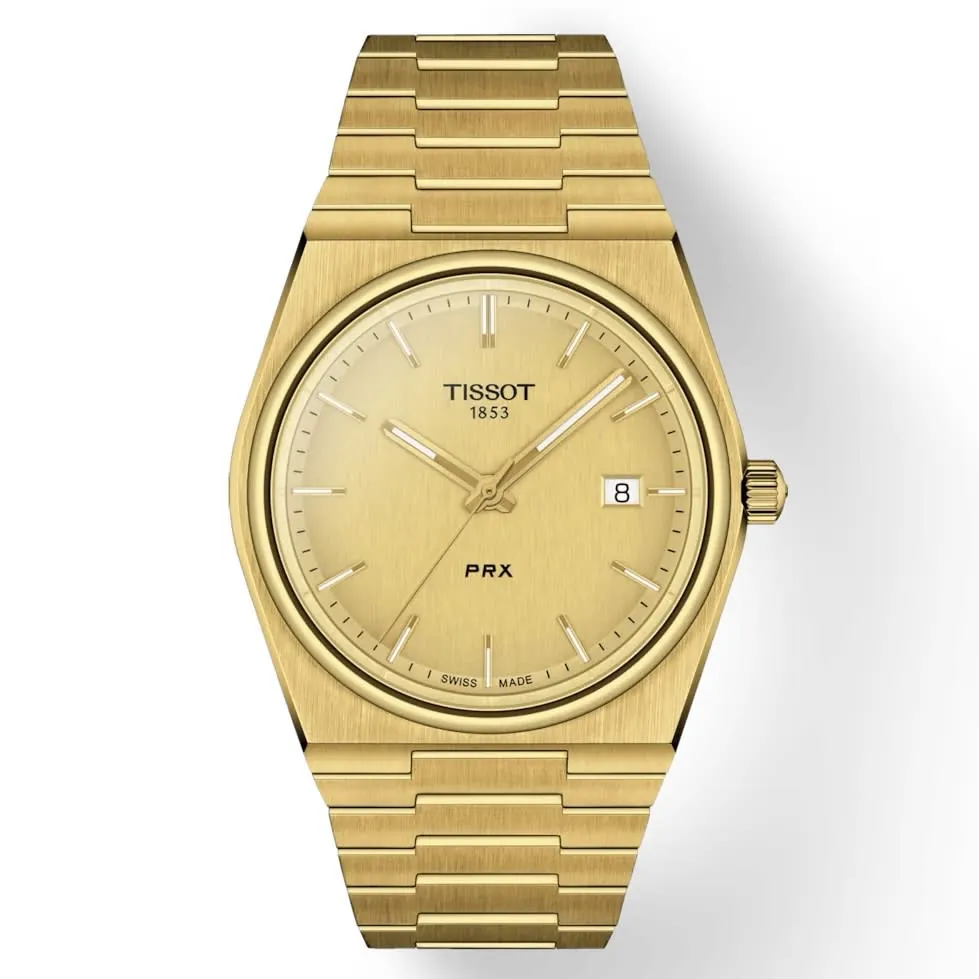
Tissot occupies a position almost no other Swiss brand holds. It is genuinely affordable, genuinely Swiss, and — across most of its catalog — genuinely mechanical. For a lot of people it is the first watch that feels like a real watch rather than an accessory, and for plenty of others it stays in the rotation long after more expensive pieces have arrived.
This guide covers the collections worth knowing, explains the Powermatic 80 movement that sits inside most of them, and sets out what to look at before you buy. Current Tissot stock runs from about $295 to $2,150 across 23 watches, 16 of them new and 7 pre-owned.
Why Tissot
Tissot was founded in 1853 in Le Locle, in the Swiss Jura, and has stayed in that town ever since. That unbroken run matters more than it sounds: the brand has never been revived or rebuilt around a name someone bought, and the model names on the current catalog mostly point back to real products in the archive rather than to marketing.
Its modern identity rests on a single decision — to compete on value rather than prestige. Tissot builds Swiss watches with Swiss movements at prices that undercut nearly every brand with comparable specifications. The trade-off is honest and visible: sound engineering and conservative finishing rather than hand-applied decoration and precious metal.
What the Swatch Group connection means
Tissot belongs to the Swatch Group, which also owns Omega, Longines and Hamilton, and — crucially — owns ETA, the movement manufacturer that supplies much of the Swiss industry. That is why Tissot can put a modern automatic with a long power reserve into a watch at this price: the movements are developed inside the same group, at scale, and shared across sister brands with different finishing and regulation.
The practical consequence is service. Parts are widely available, independent watchmakers know these calibers well, and a service is a routine job rather than a specialist commission. Over a decade of ownership that is worth more than a fancier movement you cannot get fixed locally.
The Powermatic 80, explained
Most mechanical Tissot watches you will encounter run a Powermatic 80. It is an automatic developed within the group from the long-serving ETA architecture, and the number is the point: roughly 80 hours of power reserve from a full wind, against the 38 to 48 hours that has been the industry norm for decades.
The longer reserve comes from a reduced beat rate. Where a conventional Swiss automatic ticks at four beats per second, the Powermatic 80 runs slower, drawing less energy from the same mainspring and stretching the running time. The seconds hand sweeps very slightly less fluidly as a result; what you get in exchange is a watch that behaves better in real life.
What an 80-hour reserve means day to day
This is the feature that changes ownership, not the spec sheet. With a 40-hour movement, a watch taken off on Friday evening is stopped by Sunday morning, and Monday starts with resetting the time and the date. With 80 hours, the same watch is still running when you pick it up. A weekend off the wrist costs you nothing.
The same logic applies if you rotate between two or three watches. A long reserve means a watch can sit out a few days without dying, which makes a small collection far less fussy to live with. None of this is glamorous, but it is the single most useful thing a movement at this price can offer, and it is much of the argument for buying Tissot at all. Our guide to watch movements explained covers how automatic, quartz and manual calibers differ if the terminology is new.
Accuracy, magnetism and silicon
A Powermatic 80 is a workhorse rather than a precision instrument, and should be judged that way. It keeps good time for the price, and a watchmaker can regulate one closer if you want. Some references go further: certain Ballade and Heritage models carry COSC chronometer certification, meaning the movement was independently tested against a defined accuracy standard before casing.
Newer versions of the movement use a silicon balance spring, which is effectively immune to magnetic fields. That is a real advantage in a life full of laptops, speakers and magnetic phone stands: magnetism is the most common reason a mechanical watch suddenly runs badly, and silicon removes the problem rather than mitigating it. The Gentleman and several Ballade references are where to look if this matters to you.
The collections
Tissot's range is broader than most people realize, and the names can be confusing because several come straight from the archive. Here is how the collections in the current Tissot range actually differ.
| Collection | Character | Best for |
|---|---|---|
| PRX | Integrated steel bracelet, 1970s revival | The one-watch daily wear |
| Seastar 1000 | Dive watch with rotating bezel | Water, travel, weekends |
| Le Locle | Classic dress watch, Roman numerals | Office and formal wear |
| Gentleman | Clean, slim, sport-dress hybrid | Work-to-weekend all-rounder |
| Ballade | Dress line, chronometer-certified references | Formal wear, certified accuracy |
| Heritage | Faithful archive reissues | Vintage taste, character |
| PRS 516 / T-Race | Motorsport-inspired chronographs | Sporty wear, larger wrists |
PRX — the one most people come for
The PRX revives a Tissot design from 1978: a thin case flowing directly into an integrated steel bracelet, with no visible lugs and a tapering, close-fitting line around the wrist. The name comes from the original's precise and robust billing, with the X standing in for the Roman numeral ten and the watch's water resistance rating.
It works because the proportions are right. Integrated-bracelet watches are hard to get correct — the bracelet has to meet the case cleanly and the whole thing has to sit flat — and the PRX manages it at a price where almost nothing else does. In stock you will find the PRX Powermatic 80 (T137.407.11.351.00) and the PRX Gradient (T137.407.11.351.01) with the automatic movement, the PRX Chronograph (T137.427.11.041.00), and quartz references including the PRX (T137.410.33.021.00) and the PRX (T137.210.11.081.00) in smaller sizes. If you want one watch that handles a meeting, a dinner and a weekend without looking out of place, this is the obvious pick.
Seastar 1000 — the dive watch
The Seastar is Tissot's diver and a serious one on paper: a unidirectional rotating bezel, a screw-down crown and 300 meters of water resistance, which is well beyond anything recreational diving demands. The Seastar 1000 (T120.807.11.091.00) and the Seastar 1000 (T120.407.11.051.00) are the references currently in stock.
What makes it interesting is that this is a properly specified dive watch at a price where most competitors are making dive-styled watches instead. If you are shopping the category across brands, our dive watch buying guide sets out what actually matters — bezel action, lume quality, crown security — as opposed to what gets advertised.
Le Locle — the classic
Named for the town Tissot has never left, Le Locle is the brand's traditional dress watch: Roman numerals, a textured dial center, a slim case and usually a leather strap. Two references are in stock, the Le Locle (T006.207.22.096.01) and the Le Locle (T006.207.11.096.00).
Buy one if you need something for a suit, or if the vintage-leaning look appeals more than a sports watch does.
Gentleman — the quiet all-rounder
The Gentleman is the collection people overlook and then end up recommending. It has a clean, unfussy dial, applied markers, a slim case and enough restraint to work under a cuff while still looking correct with a T-shirt. The Gentleman (T127.407.11.041.00) and the Gentleman (T127.407.11.091.01) are both in stock, and this line is where you will most often find the silicon balance spring.
If someone asks for a first Swiss automatic and gives no other information, the Gentleman and the PRX are the two answers. The Gentleman is the more versatile; the PRX has more personality.
Heritage, Ballade and the sports chronographs
The Heritage line reissues designs from the archive. The Heritage 1973 Blue Dial and the Heritage 1973 Stainless Steel are period-correct racing chronographs. The Heritage Navigator Automatic 160th Anniversary COSC Silver Dial marks the brand's 160th year and carries chronometer certification. The Heritage Porto Mechanical Stainless Steel is a hand-wound, cushion-cased dress piece with an interwar feel, and the Sideral S Powermatic 80 (T145.407.97.057.00) revisits a 1970s Tissot experiment in unconventional case construction.
The Ballade references — T156.208.11.353.00, T156.408.11.093.00 and T156.408.11.043.00 — make up the dress line with certified movements. For a motorsport character there is the PRS 516 Automatic Chronograph and the PRS 516 Automatic Chronograph Black Arabic Dial, both descended from Tissot's racing watches of the 1960s, plus the T-Race Automatic Chronograph Black Dial with its motorcycle-inspired detailing. The PR 100 Sport Chic (T101.910.11.121.00) rounds out the range as a slim, quartz-powered everyday option.
Sizing and fit
Tissot cases run sensibly rather than fashionably, and most of the range suits an average wrist. Two things matter more than diameter: lug-to-lug length, which determines whether the watch overhangs your wrist, and thickness, which decides whether it slides under a shirt cuff.
The PRX is the special case, because an integrated bracelet has no lugs and wraps immediately. That makes it wear smaller and flatter than the specification suggests, and it suits narrower wrists better than most sports watches its size. The chronographs — the PRS 516 and the T-Race — are the largest and thickest watches in the range, and they need a wrist to carry them.
New or pre-owned
Tissot is one of the few brands where buying new is genuinely reasonable: retail pricing is modest to begin with and there are no waitlists to work around. Of the 23 Tissot watches currently in stock, 16 are new and 7 are pre-owned, so both routes are open.
Pre-owned still makes sense in two situations. One is when you want a discontinued reference, a dial color no longer produced, or a Heritage piece from an earlier run. The other is simple value: a well-kept pre-owned example leaves budget for a strap, a service, or a second watch. Our guide on how to buy a pre-owned luxury watch covers the process end to end, and it applies here as much as further up the market.
What to check
- Reference number. Tissot references are long and specific, encoding the exact dial and bracelet configuration. Confirm the reference on the caseback matches the watch and the listing.
- Bracelet condition. On an integrated-bracelet PRX this matters more than on any other Tissot, because the bracelet is not easily replaced. Check for sag and side-to-side play in the links.
- Crystal and bezel. Look across the crystal at an angle for scratches, and turn a Seastar bezel through a full rotation listening for even, positive clicks.
- Power reserve behavior. A Powermatic 80 that stops well short of its rating after a full wind is telling you it needs service.
- Water resistance. Gaskets age. If you plan to swim with a Seastar, have it pressure-tested rather than trusting the number stamped on the caseback.
Tissot against its neighbors
The most useful comparison is with the brands sitting immediately around it. Hamilton is the closest sibling — same group, similar movements, American-heritage design language and a strong field-watch and aviation catalog. Choose Hamilton for a Khaki Field; choose Tissot for an integrated bracelet or a dress watch.
Above Tissot sits Longines, which shares the group connection but adds better finishing, more elaborate dials and a deeper archive to draw reissues from — a real step up in refinement, priced accordingly. Outside the group, Oris is independent and builds its reputation on divers and its own long-reserve caliber, while Tudor and Omega sit a tier above again, where in-house movements and chronometer certification are standard rather than reserved for particular references.
Where Tissot wins is the ratio. Nothing else offers Swiss mechanical watchmaking with an 80-hour reserve at these prices. Our roundup of the best luxury watches under $5,000 puts the whole tier in context if you are weighing options across brands.
How to choose
Work backward from how you will wear it. If you want one watch for everything, the PRX or the Gentleman. If you swim, sail or simply prefer a bezel, the Seastar. If your week involves a suit, Le Locle or a Ballade. If you want age in the design, the Heritage line. If you want a chronograph and have the wrist for it, the PRS 516.
Then decide on movement type honestly. An automatic is the more engaging object and the Powermatic 80 makes one easy to live with, but a quartz PRX or PR 100 needs no attention at all and stays thinner. There are quartz references in the current range for exactly that reason.
Whichever you land on, buy it somewhere that stands behind the watch. Every Tissot we sell is inspected and certified genuine under our Authenticity Guarantee, shipped free and insured within the US, and covered by our 2-year movement warranty with 14 days to return it. Browse the full Tissot collection, compare it against the wider catalog of 650 watches across 40 brands, or get in touch if you are after a reference we do not currently have.