
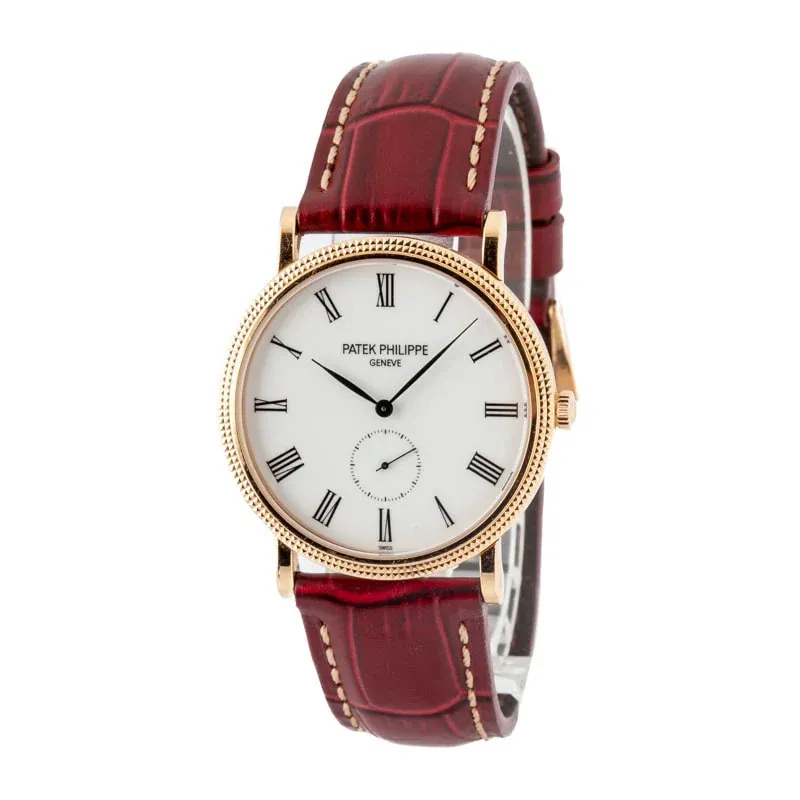
Founded in Geneva in 1839 and still run by the Stern family, Patek Philippe is the rare watchmaker that has never been absorbed into a larger group. It is also the one whose name carries most weight in a room full of collectors. Buying one is a different exercise from buying a sports watch, and the questions worth asking are different too.
This guide is practical rather than reverent. By the end you should understand how the collections divide up, how to read a reference number and the letter on the end of it, why a gold dress watch is often the sensible way in, and what the Extract from the Archives is. Our current Patek Philippe stock runs from about $6,900 to just under $98,000 across 22 pre-owned watches.
What sets Patek apart
Two things, mainly. The first is continuity of ownership and record-keeping. Patek has stayed independent, and it has kept records of the watches it has made since the beginning — which is the foundation of the Extract from the Archives discussed below, and the reason provenance on a Patek can be established with a certainty that is unusual in this market.
The second is where the company puts its effort. Adrien Philippe's keyless winding system — the crown, in other words — was a Patek contribution to the whole industry, and the firm has spent most of its history at the difficult end of watchmaking: perpetual calendars, minute repeaters, split-seconds chronographs, world time. Patek certifies its own finished watches under the Patek Philippe Seal, having previously used the Geneva Seal, and that standard covers the completed watch rather than the bare movement alone.
For a buyer, this means you are paying for finishing and complication work rather than ruggedness. A Patek is not a tool watch, and rewards being treated accordingly.
The collections, and how they fit together
The catalog looks sprawling but resolves into four ideas: a dress watch, a complicated watch, a sports watch, and a shaped-case watch. Almost everything sits in one of those buckets.
Calatrava — the dress benchmark
The Calatrava is the reference point for the round dress watch, and has been since the 1930s original. The formula barely changes: a modest round case, a clean dial, applied markers or Roman numerals, a leather strap, and a thin automatic or hand-wound movement underneath. Some versions have the Clous de Paris hobnail bezel, some are entirely plain.
That restraint is the point. A Calatrava is the watch other dress watches are measured against, and the easiest Patek to wear every day without thinking about it. In our current stock it is represented by the 5119R in rose gold and the 5120J in yellow gold — the same design language in two metals.
Complications and Grand Complications
This is where Patek's reputation was built. The Complications family covers annual calendars, world time, moon phases, chronographs and combinations of them; the Grand Complications sit above with perpetual calendars, minute repeaters and split-seconds work. The annual calendar in particular is a genuinely useful invention — it tracks months of different lengths and only needs correcting once a year, at the end of February — and Patek's annual calendar references are among the most wearable complicated watches anyone makes.
Our stock in this area includes the Annual Calendar 5036 in yellow gold, the 4968R with a mother of pearl dial, the 5930G world time chronograph with a blue dial in white gold, and the 5015P in platinum, alongside several ladies' Complications references. If the terminology is unfamiliar, our guide to watch complications explained covers what each one does and what it costs you in servicing and complexity before you commit to one.
One caution: complications are bought because you want them, not because they are a better purchase. They raise the price and the service bill both.
Nautilus and Aquanaut — the steel sports line
The Nautilus arrived in 1976, designed by Gerald Genta, and it did something Patek had never done: put the brand's name on a steel sports watch with an integrated bracelet. The porthole-inspired case with its hinged ear pieces and horizontally grooved dial has proved extraordinarily durable as a design. The Aquanaut followed in 1997 as a younger, more casual interpretation with a rounded-octagon case and a molded composite strap.
These generate most of the noise around the brand, and demand for them — particularly in steel — has been intense for a long time. Precious-metal versions are usually easier to find and, to many eyes, better looking. Our current Nautilus stock includes a rose gold chronograph, and the Aquanaut is represented by a 5067A with a diamond bezel and a ladies' 4960A in steel. The Neptune 5080, a discontinued sports reference, also appears in our stock — a quieter alternative for anyone who likes the format but not the attention.
Gondolo and the shaped cases
Gondolo covers Patek's rectangular, tonneau and cushion-cased watches, a line named for the Brazilian retailer that sold enormous numbers of Patek pocket watches in the early twentieth century. These are Art Deco in spirit and wear completely differently from a round case — longer, flatter, more formal. The Gondolo 5135G in white gold in our stock is a good example. Shaped cases are a minority taste, which is precisely why they can represent good value.
How to read a Patek Philippe reference number
Patek references are short and informative once you know the grammar. A modern reference is generally a four-digit model number, optionally a slash and a digit or two, then a letter for the case metal, then a dash and a three-digit dial code. So 5119R-001 is model 5119, in rose gold, with a particular dial. A /1 before the metal letter usually indicates a bracelet rather than a strap.
The letter is the part that does the most work, and it comes from French. Every one of them is represented in our current stock, which makes them easy to learn:
| Suffix | Metal | From | Example in our stock |
|---|---|---|---|
| R | Rose gold | rose | Calatrava 5119R; Complications 4968R |
| J | Yellow gold | jaune | Calatrava 5120J; Annual Calendar 5036 |
| G | White gold | gris | World time chronograph 5930G; Gondolo 5135G |
| P | Platinum | platine | Complications 5015P |
| A | Steel | acier | Aquanaut 5067A; ladies' Aquanaut 4960A |
Two things follow. First, the same model number in two metals is the same watch in a different material, which makes cross-shopping straightforward: if you like the 5119 but not rose gold, look for the same reference in another letter. Second, older references — the yellow gold 3491 in our stock, for instance — often carry no metal suffix at all, because the convention was adopted over time. Absence of a letter on a vintage reference is normal, not a warning sign.
One detail worth knowing: Patek sets a small diamond into the case band at six o'clock on its platinum watches. It is a discreet and useful marker.
Gold and platinum dress references as the way in
The counterintuitive fact about Patek is that the accessible end of the brand is precious metal. Steel sports models attract the most demand and sit at the top of the market as a result, while a gold Calatrava or an older gold Complications reference can be had for considerably less. That is where the lower end of our own price range sits.
There are good reasons to prefer a dress reference beyond price. A thin gold case on a leather strap is more comfortable than an integrated steel bracelet for most wrists, it is more quietly worn, and it is closer to the brand's center of gravity: Patek has made dress watches for its whole existence and sports watches for part of it. If you are weighing how this fits into a broader picture of what luxury watches do with value over time, our piece on the best luxury watches for investment is the right place to look. Patek's value retention has historically been strong, but buy the watch you want to wear and let that take care of itself.
Papers, and the Extract from the Archives
Every brand's paperwork matters on the pre-owned market. Patek's matters more, and it works differently.
Modern Patek watches are sold with a Certificate of Origin, the brand's version of a warranty card, showing the reference, the case and movement numbers and the selling date. A complete set — certificate, box, accessories, and the setting pin on a calendar model — is meaningfully more desirable than a bare watch. But paperwork can be separated from a watch, lost, or faked, which is why the second document exists.
What an Extract from the Archives confirms
Patek keeps records for the watches it has produced, and any owner can apply to the manufacture in Geneva for an Extract from the Archives. Issued by Patek Philippe itself, it states what the company's own records say about that specific watch: the movement number, the case number, the reference, the type of case metal and dial, and the dates on which the watch was manufactured and sold. There is a fee and it takes time, but it is the authoritative provenance document for the brand.
What it gives you is confirmation that a watch with those numbers left the factory in that configuration. That matters in two situations. The first is a watch without its original papers, where an Extract can substantially restore confidence and marketability. The second is a watch that looks unusual — an uncommon dial, an unexpected metal, a configuration you cannot find elsewhere — where the Extract either confirms it as factory-original or reveals that it is not. Dial swaps and refinished dials are the most common way value quietly disappears from a vintage Patek, and this is the one document that speaks to it with authority.
So: on any pre-owned Patek, ask whether an Extract exists. If one does, read it against the watch in front of you and confirm the case and movement numbers agree. If one does not, establish that the seller will support an application. On a modern reference with full papers it is less critical; on anything vintage, unusual or expensive it is close to essential.
What to check on a pre-owned Patek
- Case sharpness. Gold is soft and polishes away quickly. Look at the lugs and case flanks — original proportions and crisp edges matter far more than a mirror finish.
- Dial originality. Refinished dials are common on older watches and are a significant deduction. Check printing quality, text alignment and the finish of the applied markers.
- Numbers. The case, movement and reference numbers should agree with each other and with any paperwork or Extract.
- Complication function. On a calendar or world time model, have every function cycled and checked before purchase, not just the time.
- Service history. Ask when the watch was last serviced, by whom, and whether original parts were retained. Vagueness is a reason to pause.
The process is the same as for any high-value secondhand purchase, and our guide to buying a pre-owned luxury watch covers it end to end. Counterfeits and, more insidiously, watches assembled from mismatched genuine parts exist at this level; how to spot a fake luxury watch covers the tells. The best protection is a seller who guarantees the watch in writing. Everything we sell is inspected and covered by our Authenticity Guarantee and 2-year movement warranty.
Servicing and living with one
Patek will service watches it has made across its history, an unusual commitment and part of what the brand charges for. It also means service goes to Geneva or an authorized center rather than to whoever is nearest, and that complicated movements take longer and cost more than simple ones. Budget for this before you buy — a perpetual calendar is a different financial proposition from a time-only Calatrava over twenty years of ownership.
Day to day, the habits are straightforward. Keep a hand-wound watch on a consistent winding routine. Do not adjust a calendar complication during the hours around midnight when the change mechanism is engaged. Keep gold cases away from hard knocks. Our watch care guide covers storage and travel. Patek's long-running advertising line about caring for a watch on behalf of the next generation is marketing, but the idea underneath it is sound.
Where to start
If you want one Patek and no complications, a Calatrava in the metal you prefer is the correct answer and always has been. If you want the brand's real character, an annual calendar or a world time reference gives you something you will never tire of looking at. If you want a steel sports watch and are prepared for the competition, the Nautilus and Aquanaut are what they are. A shaped Gondolo is the least obvious choice on the list.
Cross-shopping is reasonable at this level. Audemars Piguet plays in the same integrated-bracelet territory, and Rolex offers a different kind of durability and liquidity if those matter more to you than finishing. But nothing quite substitutes for a Patek if a Patek is what you have decided you want.
Browse the current Patek Philippe collection — all pre-owned, all inspected and guaranteed authentic — or get in touch if you are looking for a particular reference. At this end of the market patience is the cheapest advantage you have.