
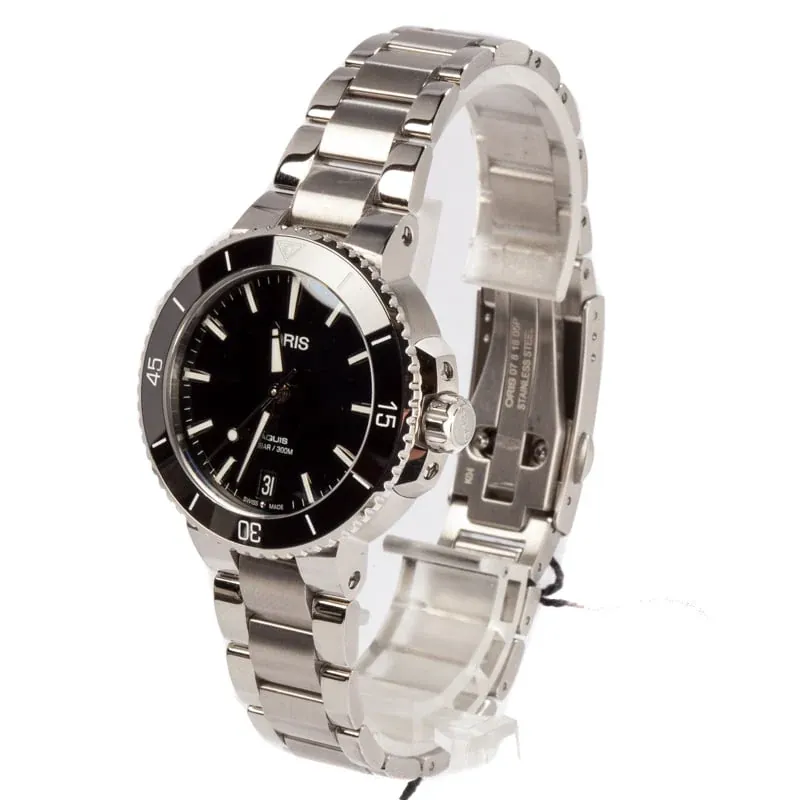
Oris is one of the few Swiss watch companies of any real size still owned by the people who run it. There is no luxury conglomerate above it and no publicly traded parent, and the head office remains in Hölstein, the small Baselland village where the company was founded in 1904. That independence is the most useful single fact about the brand, because nearly everything distinctive about an Oris follows from it: the mechanical-only catalog, the red rotor visible through the caseback, and the decision to develop an in-house movement family from a standing start.
This guide covers the collections you are most likely to be choosing between — the Aquis divers, the vintage-inspired Divers Sixty-Five, the Big Crown and ProPilot aviation lines, and the dressier Artelier. It explains what Calibre 400 changed, how to read an Oris reference number, and where the brand's value sits against names that cost several times more.
Why Oris
Oris spent the middle of the twentieth century as a large, conventional Swiss manufacturer, and like most of the industry it was absorbed into a corporate group during the quartz upheaval. A management buyout in the early 1980s pulled it back out. The company that emerged made two decisions that still define it: stay independent, and build mechanical watches only.
The second is more radical than it sounds. Most brands at this price point sell quartz alongside automatics because quartz is cheaper to make and easier to sell. Oris does not. Every watch in the catalog is a wound spring driving a mechanical escapement, so every watch needs winding or wearing, runs within mechanical tolerances rather than to the second, and can be serviced indefinitely. If you are new to the distinction, our guide to watch movements explains what that commits you to.
Independence also shows up in pricing. A brand that answers to a group has margin targets set elsewhere; a brand that answers to itself decides what a watch should cost. Oris consistently sits below where its specification and finishing would place it, and that gap is why enthusiasts recommend it so persistently.
The collections at a glance
| Collection | Character | Best for |
|---|---|---|
| Aquis | Modern dive watch, ceramic bezel, integrated case lines | An everyday sports watch that can genuinely swim |
| AquisPro / ProDiver | Serious depth-rated tool divers, titanium construction | Buyers who want maximum capability and presence |
| Divers Sixty-Five | Vintage-inspired, domed crystal, softer proportions | Smaller wrists and anyone who finds modern divers bulky |
| Big Crown Pointer Date | Oversized crown, central date hand, aviation heritage | A distinctive daily watch with real history behind it |
| Big Crown ProPilot | Contemporary pilot design, big date and altimeter variants | Instrument character without vintage styling |
| Artelier | Classic round dress watches, moonphase and hand-wound options | Formal wear and the brand's most traditional finishing |
Aquis
The Aquis is the collection most people mean when they say Oris. It is a proper dive watch — screw-down crown, unidirectional ceramic bezel, serious water resistance — but the case is sculpted rather than slab-sided, with the lugs and bracelet flowing out of the case in a way that reads as designed rather than merely engineered. That is why an Aquis works under a shirt cuff when many dive watches do not.
Dial colors are where the line has real range. Current stock includes the standard black and blue steel models, several greens including the Calibre 400 versions, the Taste of Summer pieces in green and red, a pink mother-of-pearl execution and a multicolored dial. There are also conservation-linked limited editions such as the Oris x Bracenet Aquis, which uses reclaimed fishing net material, and the Aquis New York Harbor Limited Edition II. If you are cross-shopping the category rather than the brand, our dive watch buying guide sets out what actually matters in a diver.
Above the standard Aquis sit the AquisPro and the ProDiver, both built for greater depth and both using titanium to keep the weight sensible — which it needs to be, because these are large watches with thick cases. The ProDiver Chronograph in titanium is the most imposing thing Oris makes.
Divers Sixty-Five
The Divers Sixty-Five is a reissue in spirit rather than a slavish copy: a mid-century dive watch reinterpreted with a domed crystal, a lightly aged aesthetic and proportions that sit far closer to the wrist than a modern diver. It comes in several case diameters, including genuinely small ones, which makes it easy to recommend to someone with a slim wrist.
It is also the most versatile watch in the range. On a textile or leather strap it reads as a casual watch rather than a piece of equipment, and its lower water-resistance rating is irrelevant for anything short of actual diving. The blue-dial steel model on a textile strap in our current Oris stock shows how differently the same brand can present itself.
Big Crown and Big Crown ProPilot
The Big Crown is the oldest idea in the catalog, and the name is literal: the winding crown is oversized so a pilot could set the watch without removing gloves, a design dating to the late 1930s. The pointer date is the other signature — instead of a window, a fourth central hand sweeps a date scale around the dial edge. It is a genuinely useful complication and a rare one, and it gives the Big Crown Pointer Date a face nothing else on the market resembles. Current stock includes the Bullseye dial and two other Pointer Date references.
The Cervo Volante models sit in the same family and use leather from Swiss deer, part of the brand's habit of building limited runs around a material or a cause rather than a color. The Big Crown ProPilot is the contemporary aviation line: flatter, more instrument-like, with a fluted bezel and a big date option. The ProPilot Altimeter is the outlier — a mechanical altimeter driven by a pressure aperture in the case, read against a scale on the dial, and quite unlike anything else at the price.
Artelier
Artelier is the classical side of Oris. The Grande Lune adds a moonphase and a date, and the diamond-set executions push the line dressier still. It is also where the hand-wound in-house movement lives, which is why a collector who has written Oris off as a dive-watch brand should look here first.
The red rotor
Turn most automatic Oris watches over and the winding rotor is red. It began as a way to make the brand identifiable through a display caseback and has become the closest thing Oris has to a signature you can feel rather than merely recognize. It is a small thing, but it says something true about the company: the movement is meant to be looked at, not hidden, even on watches at the accessible end of the range.
Calibre 400 and the in-house movements
For most of its modern history Oris built its watches on outside base calibers, modified in-house. That changed with the Calibre 400 family, and it is the most consequential thing the brand has done in decades.
Calibre 400 is an automatic movement with two mainspring barrels giving roughly five days of power reserve, silicon components in the escapement for high resistance to magnetism, and a construction designed for long service intervals rather than maximum decoration. Oris backs it with a ten-year warranty on registration and a recommended ten-year service interval — a claim only possible for a movement the company controls end to end. In ownership terms: a watch you can take off on Monday and pick up on Friday still running, that ignores your laptop, and that will not ask for a service bill for a decade.
You will find it in the Aquis Date Calibre 400 models, the AquisPro Date in titanium, and the ProPilot X — the last being the most modern-looking watch Oris makes, in titanium with the movement architecture on display through the dial.
The hand-wound 110 family
The other in-house line is older and quieter. Developed for the company's 110th anniversary, it is a hand-wound movement with a ten-day power reserve from a single very long mainspring, paired with a patented non-linear power reserve indicator that stretches the final part of the scale so you can read it precisely when it matters. Calibre 111 adds a date. The Artelier Calibre 111 in the current range is the accessible way into a movement that is, by any reasonable measure, serious watchmaking.
What about the sourced calibers?
Most of the range still runs Oris-numbered calibers built on Sellita bases and adjusted in-house — the 733, 751 and 754 families you see in the reference numbers. This is not something to apologize for. These are the workhorses of Swiss watchmaking: well understood by every competent watchmaker, inexpensive to service and difficult to kill.
Reading an Oris reference number
Oris references look forbidding and are actually simple. A number like 01 754 7779 4061 breaks into parts: the leading 01 is a constant, the next three digits are the caliber, the following four identify the case and model, and the final block describes the dial and execution. Once you know that, the reference tells you what is inside before you read a specification sheet.
It also lets you spot the in-house watches instantly. A reference beginning 01 403 carries a Calibre 400-family movement — the Big Crown Pointer Date at 01 403 7799 4067 in current stock is exactly that, an in-house five-day movement in the brand's most traditional case. A 733, 751 or 754 in that position tells you it is a modified Sellita base. Neither is wrong; you simply want to know which you are buying, and the reference will not lie to you.
Value against bigger names
The honest case for Oris is that you get more watch for the money and less recognition for it. A stranger will not identify an Aquis across a table the way they would identify a Submariner. In exchange you get Swiss manufacturing, ceramic bezels, sapphire crystals, real dive ratings and — increasingly — an in-house movement, well under what the badge-led brands ask.
Against Tudor, Oris is generally the cheaper and more distinctive option, with Tudor holding an edge in resale and bracelet finishing. Against Longines, the two are close competitors, with Longines leaning on archive heritage and Oris on independence and its own movements. Against Hamilton, Oris sits a step up in price and finishing. All three are worth cross-shopping, and our roundup of the best luxury watches under $5,000 puts them in wider context.
On resale, be realistic. Oris holds value reasonably for what it is, but this is not a brand you buy as an asset — the discount you enjoy buying is the same discount the next owner will expect. Current Oris stock runs from about $595 to $4,500 across 40 watches, 23 of them new and 17 pre-owned, which covers essentially the whole brand from an entry Big Crown to the in-house and limited-edition pieces.
Buying Oris pre-owned
The general process is the same as for any secondhand watch, and our guide to buying a pre-owned luxury watch covers it end to end. A few checks are worth emphasizing for this brand.
- Confirm the caliber from the reference. Several models exist in both sourced-caliber and Calibre 400 versions with similar dials. The three digits after the 01 settle it.
- Check the ceramic bezel insert. Ceramic resists scratching but chips if struck hard on an edge. Look where the bezel meets the case, at an angle, in good light.
- Test the bezel and crown action. The bezel should click firmly in one direction only, and the screw-down crown should thread smoothly — grit or cross-threading tells you how the watch has been treated.
- Ask about pressure testing. Water resistance depends on gaskets that age. On any diver, a recent test matters more than the number on the caseback.
- Ask what has been serviced. A vague answer, on a watch with no remaining factory warranty behind it, should shape what you are willing to pay.
Everything we sell is inspected and guaranteed genuine under our Authenticity Guarantee, covered by a 2-year movement warranty, and shipped free and insured within the US with 14 days to return it.
How to choose
Start with how you dress. If you live in a shirt and jeans and want one mechanical watch that handles everything including water, buy an Aquis — the Calibre 400 version if the budget reaches it. If you have a smaller wrist or find modern divers overbearing, the Divers Sixty-Five is the better watch. If you want something nobody else at the table is wearing, the Big Crown Pointer Date and the ProPilot Altimeter are the two most individual pieces in the catalog. For a dress watch, the Artelier, and the hand-wound Calibre 111 if you want the movement to be the reason.
Then set the budget honestly and stop comparing to brands you were never going to buy. Oris is not trying to be a status object, and measuring it against one misses what it is good at. Browse the full Oris collection, or get in touch if you want a specific reference sourced.