
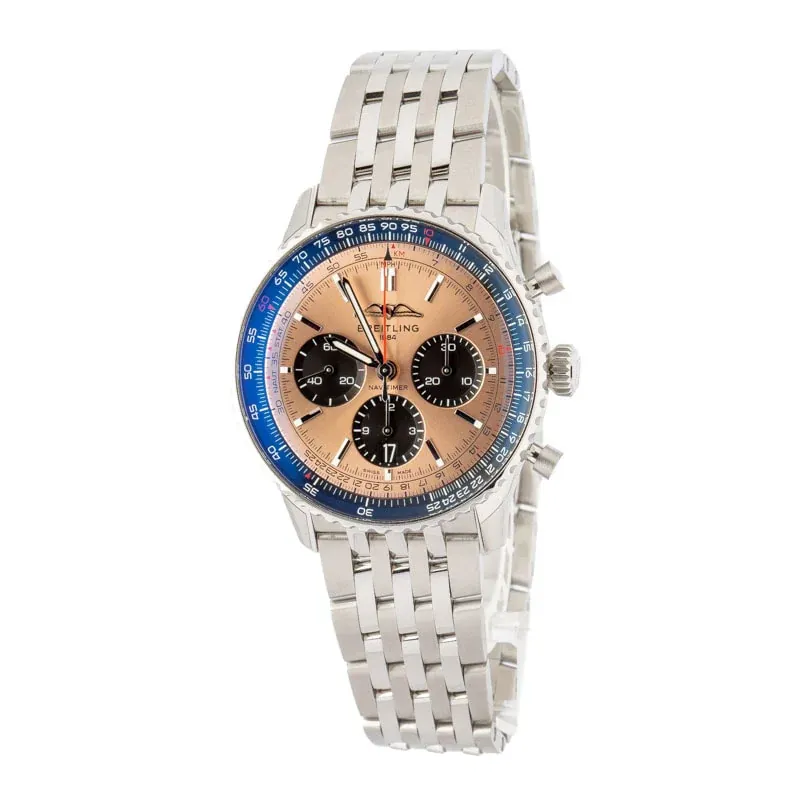
Breitling is a chronograph brand first and everything else second. The company has been making timing instruments since the 1880s, and for most of the twentieth century its customers were pilots, navigators and people who needed to measure elapsed time accurately enough to act on the result. That history still shapes the catalog, which is why a Breitling tends to look busier, wear larger and take itself more seriously as a tool than its competitors do.
That also makes the brand harder to shop than it looks. Two watches with similar names can carry very different movements, the same collection can span nearly ten millimeters of case diameter, and some of the most interesting pieces in the range are quartz rather than mechanical. This guide sets out how the lineup is organized, what the slide rule bezel actually does, which caliber you are likely to be buying, and what to check on the pre-owned market. If you have not bought secondhand before, read it alongside our guide to buying a pre-owned luxury watch.
How the lineup is organized
Breitling groups its watches by environment: air, land and sea. It is marketing language, but unusually honest marketing language, because the collections really were designed for different jobs and they feel different on the wrist.
The air side is the historic core — the Navitimer above all, with its circular slide rule, and the Aerospace and Avenger lines as the modern instrument watches. The sea side centers on the Superocean, a dive line that has run for decades, and its retro-styled sibling the Superocean Heritage. The land side covers the Chronomat and Endurance Pro, built for sport and general wear rather than a specific profession. Sitting apart from all three are the dressier chronographs — the Premier and the Transocean — which trade the tool-watch furniture for cleaner dials and slimmer cases.
| Collection | Character | Suits |
|---|---|---|
| Navitimer | Pilot chronograph with slide rule bezel; busiest dial in the range | Buyers who want the signature Breitling and do not mind complexity |
| Chronomat | Sport chronograph, rider-tab bezel, integrated-feel bracelet | A single do-everything watch worn hard |
| Superocean Heritage | Dive watch with vintage styling and a ceramic bezel | Water use, weekends, casual wear |
| Aerospace | Titanium multifunction quartz, analog-digital display | Travel and daily practicality over mechanical romance |
| Endurance Pro | Lightweight Breitlight case, sport quartz, bold color | Running, gym, hot climates |
| Premier and Transocean | Dressier chronographs, restrained dials | Office wear and anyone who finds the sports models loud |
The Navitimer and what the slide rule really does
The Navitimer arrived in the early 1950s and was adopted as the official watch of the Aircraft Owners and Pilots Association, which is why early examples carry the winged AOPA logo. It is the watch most people picture when they hear the brand name, and the rotating bezel around the dial is the reason.
How it works
That bezel is a circular slide rule. The outer scale rotates against a fixed inner scale, and because both are logarithmic, lining up two numbers performs multiplication or division. In practice that means you can work out fuel burn over a given flight time, convert nautical miles to statute miles or kilometers, calculate average speed from distance and elapsed time, or do any arithmetic that would otherwise need a calculator. Pilots used it for exactly those tasks before electronic flight computers were standard equipment.
It takes ten minutes to learn and rather longer to become quick with. Almost nobody uses it seriously now, and that is fine — it is the defining visual element of the watch and the reason the dial reads as an instrument rather than a decoration.
Who it suits
The Navitimer suits someone who wants the most recognizable Breitling and enjoys a busy dial. It suits people less well if legibility at a glance is the priority; the slide rule scales crowd the outer dial and the chronograph registers compete for attention. Be honest with yourself about that density, because it is the whole point and it will not fade with familiarity. The line is broader than its reputation suggests, though. Alongside the full chronograph there are simpler three-hand versions in much smaller cases, and at the top of the range a perpetual calendar that tracks month lengths and leap years without adjustment — our guide to watch complications explained covers what that involves.
Chronomat, Superocean and the sport side
The Chronomat is the other pillar of the modern brand. It was developed in the 1980s in partnership with the Italian air force aerobatic team, and its identifying feature is the set of raised rider tabs at the quarters of the bezel, originally there so the bezel could be gripped and the crystal protected. It is a broad family: chronographs in the low forties of millimeters, three-hand versions in far smaller cases, and stone-set variants at the top. It is arguably the most wearable Breitling if you want one watch for everything.
The Superocean covers the water. The Heritage versions take the styling of the brand's early divers and pair it with a modern ceramic bezel insert, and the 44mm chronograph is the largest of them. Bezel action, water resistance and legibility matter more here than heritage; our dive watch buying guide sets out what to look for. The Endurance Pro sits at the sporty extreme of the range — a lightweight case, a quartz movement and bright accent colors, aimed at people who want to run and swim in it rather than admire it.
Movements: B01, ETA bases and SuperQuartz
This is where Breitling buying gets technical, and where two similar-looking watches differ most.
The in-house B01
The B01 is Breitling's own automatic chronograph caliber, introduced at the end of the 2000s and now the engine in the headline chronographs across the Navitimer and Chronomat lines. It uses a column wheel and a vertical clutch — the arrangement that gives a clean pusher feel and a chronograph seconds hand that starts without stutter — and its power reserve is long enough that a watch taken off on Friday is still running Monday morning. It is chronometer-certified. When a modern Breitling has "B01" in its name, this is what you are paying for.
Older ETA-based calibers
Before and alongside the B01, Breitling used modified ETA and Valjoux movements extensively, and a large share of the pre-owned market consists of those watches. There is nothing second-rate about them. The Valjoux 7750 base under many older Breitling chronographs is one of the best-understood automatic chronograph movements ever made, so any competent watchmaker can service it and parts are not a problem. It is thicker than a modern in-house caliber, but it is dependable. If the mechanics interest you, watch movements explained covers in-house versus sourced calibers properly.
SuperQuartz, and why the Aerospace matters
Breitling is unusual among luxury brands in taking quartz seriously. Its SuperQuartz movements are thermocompensated, meaning the circuit corrects for temperature change, which makes them considerably more accurate than ordinary quartz. The Aerospace is the flagship of this approach: a titanium multifunction watch with an analog dial and small digital displays, controlling a second time zone, alarm, chronograph and countdown timer through the crown alone.
Some buyers rule out quartz on principle, which is a legitimate preference but worth examining. The titanium Aerospace versions — including the B70 Orbiter, named for the balloon that made the first non-stop flight around the world — are among the most comfortable watches the brand has ever made. The Endurance Pro applies the same logic to a sportier audience.
Case sizes and the reputation for wearing large
Breitling has a well-earned reputation for big watches. Cases are thick because chronograph movements are thick, bezels are wide, and lugs are usually substantial. A 44mm Breitling wears every millimeter of it — unlike some brands whose cases wear smaller than the specification suggests. The useful news is that the sizing has spread out considerably, and the same collection may now run from the mid-thirties to the mid-forties.
| Size band | Typical examples | Notes |
|---|---|---|
| Mid-30s mm | Navitimer Automatic 35, Chronomat 36 | Three-hand, no chronograph; suits smaller wrists and dressier wear |
| 42mm | Chronomat B01 42 | The most balanced size in the range for most wrists |
| 43mm | Navitimer B01 Chronograph 43 | Large but the slide rule needs the dial space |
| 44mm | Superocean Heritage Chronograph 44, Endurance Pro 44, Chronomat 44 | Deliberately imposing; check lug-to-lug before committing |
Pay more attention to lug-to-lug span than to diameter. A 44mm case with long lugs will overhang a slim wrist noticeably, while the same diameter with short lugs may sit fine. Thickness matters too if you wear cuffs.
Materials: steel, titanium, gold and Breitlight
Most of the catalog is stainless steel, and for a chronograph that gets worn hard, steel remains the sensible default — it takes knocks and it refinishes.
Titanium is the quiet star of the range. It is meaningfully lighter than steel, it does not provoke reactions in people sensitive to nickel, and it is the reason a titanium Aerospace can disappear on the wrist in a way a steel chronograph never will. The trade-off is that titanium scratches more readily and shows wear as a duller, softer surface than the sharper marks steel picks up.
Breitlight is the brand's own material — a polymer composite, considerably lighter again than titanium, scratch-resistant, non-magnetic and warmer against the skin than metal. It appears on the Endurance Pro and parts of the Avenger line, with a matte, technical look that some people love and others find plasticky in the wrong light. Precious metal shows up mainly on the dressier chronographs, where a rose gold Transocean is a very different proposition from anything on the sport side.
Buying a Breitling pre-owned
Chronographs have more moving parts than three-hand watches, so there is more to check. Most faults reveal themselves quickly if you know where to look.
- Run the chronograph properly. Start, stop and reset it several times. The seconds hand should return to exactly zero, the pushers should feel positive rather than mushy, and the subdial hands should advance smoothly.
- Turn the slide rule bezel. On a Navitimer it should rotate both ways with even friction. A bezel that spins freely or binds in one spot suggests wear or a past repair.
- Check the dive bezel separately. On a Superocean the bezel should turn one way only, with defined clicks and minimal back-play.
- Ask about the movement by name. Whether a reference has the in-house B01, an ETA-based caliber or SuperQuartz affects both value and servicing. Get it in writing rather than inferring it from the collection name.
- Treat set stones with care. Diamond bezels exist from the factory, but they are also added aftermarket. Factory-set stones affect value very differently from aftermarket ones, so confirm which you are looking at.
- Pressure-test anything you plan to swim with. Water resistance is a property of aging gaskets, not a permanent specification stamped on the caseback.
- Look at the bracelet and clasp. Hold it horizontally from the clasp and watch for sag or lateral play. Worn links and a loose deployant are common on older examples.
- Ask for service history. Chronograph servicing costs more than servicing a simple automatic, and vagueness about when the watch was last opened is a reason to pause.
Breitling is counterfeited, though less relentlessly than the very top of the market. The dense Navitimer dial is difficult to fake convincingly, and printing quality on the slide rule scales is a useful tell — our guide to spotting a fake luxury watch covers the wider set. Everything we sell is inspected and covered by our Authenticity Guarantee and a 2-year movement warranty.
Choosing from what we actually have
A note on scope, because it matters more with Breitling than with most brands. Our Breitling selection is small and curated rather than comprehensive: 15 pieces, all pre-owned, currently running from about $1,000 to just under $12,000. Within that we have Navitimers including the B01 Chronograph 43, a 35mm automatic and a perpetual calendar; Chronomats at 42mm, 36mm and 44mm; a Superocean Heritage Chronograph 44; Endurance Pro 44 models including a Breitlight version; two Aerospace references in titanium; and dressier pieces in the shape of a rose gold Transocean chronograph and a Premier chronograph.
That spread is wide enough to represent the brand honestly — pilot, diver, professional, dress, mechanical and quartz — but it is not the whole catalog, and specific references come and go. If you want something we do not have listed, tell us what you are looking for.
As for which one to choose: buy the Navitimer if you want the watch the brand is known for and enjoy a complicated dial. Buy the Chronomat if you want a single chronograph to wear every day. Buy the Superocean Heritage if the watch will see water. Buy the Aerospace if practicality beats mechanical romance, and the Endurance Pro if you want the lightest thing on the list. Then check the size against your wrist before anything else, because a Breitling that is too big is the one mistake here that no amount of servicing will fix.
Browse the current Breitling stock when you are ready. Omega and IWC both compete directly on chronographs and pilot watches, and it is worth seeing all three before deciding.