
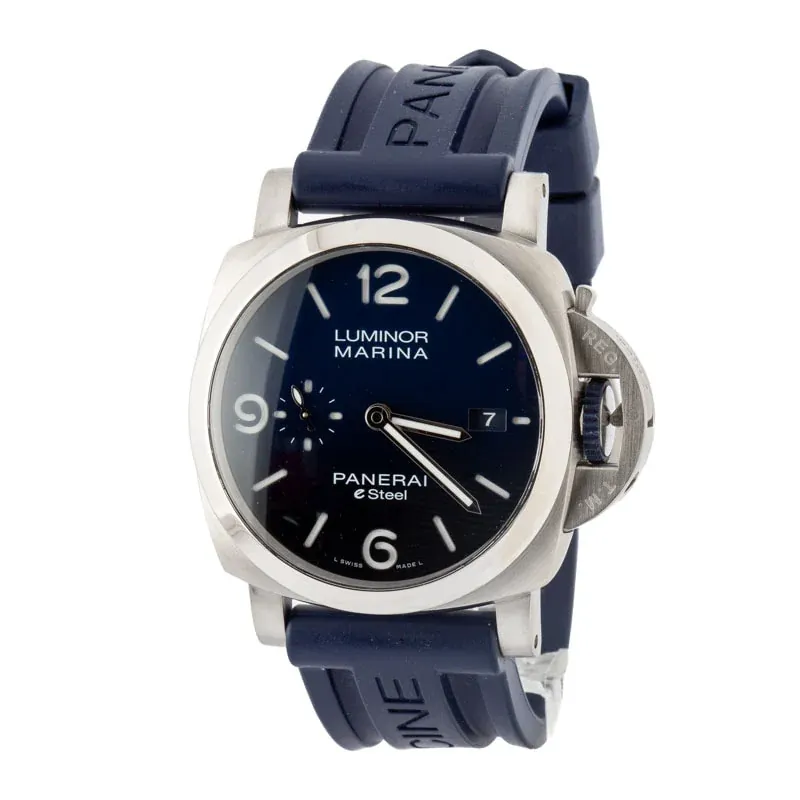
Few watch brands divide a room the way Panerai does. The cushion case, the lever bridge clamped over the crown, the presence on the wrist — it either makes immediate sense to you or it does not. What is not in dispute is that Panerai produced one of the most recognizable case designs of the last century, and that it began as instrument-making for the Italian navy rather than as a styling exercise.
This guide is for someone deciding which Panerai to buy, not whether to like them. It covers the PAM reference system, the Luminor and Radiomir case families, where the Submersible fits, what the Luminor Due is for, and — at length, because it is the most common reason a Panerai goes back in the box — how these watches sit on a wrist. If the secondhand market is new to you, read it alongside our guide to buying a pre-owned luxury watch.
The history that explains the design
Panerai started in Florence making precision instruments, and its watchmaking grew out of a supply relationship with the Royal Italian Navy. The watches were equipment issued to frogmen, and almost every design decision that looks eccentric today solved an underwater problem. The cases were enormous because a diver had to read the dial in dark water. The dials were built as two layers with luminous material sandwiched between them, the numerals cut through the top plate so the glow comes from beneath — construction that is still the signature of a Panerai dial.
Even the collection names are functional: Radiomir was the luminous compound Panerai patented for those early instruments, and Luminor the later compound that replaced it. The brand only began selling to the public in the 1990s. That history explains why the designs feel like tools rather than jewelry.
Learn the PAM number first
If you take one thing from this guide, take this. Every Panerai reference has a PAM number — PAM00232, PAM01157, PAM02973 — and it is the only reliable way to identify which watch you are looking at. Model names are shared across dozens of variants; the PAM number is not.
The counterintuitive part is that a PAM number cannot be decoded. Unlike systems where digits encode case material or bezel type, PAM numbers are assigned broadly in sequence as references are created, so a higher number means a later reference and nothing more. You cannot infer material, size or movement from PAM01661 — but you can look it up and know exactly what you are getting.
Our own stock shows why this matters. The Luminor Marina appears three times under three PAM numbers: PAM01157 with the deep blue Blu Profondo dial, PAM01358 in Grigio Roccia gray, and PAM01661 in Carbotech — one model name, three genuinely different watches in color, material and price. The same trap exists on the dive side, where a Luminor Submersible PAM00973 and a Submersible PAM02973 sit a generation apart. Shop by PAM number, confirm it matches the caseback engraving and any paperwork, and most confusion disappears. You can see how the references line up across the current Panerai collection.
The model words stacked on top
Once you have the PAM number, the words around it become easy to read:
- Base — hours and minutes only, no seconds. The Luminor Base Logo PAM00630 is the classic case.
- Logo — carries the OP logo on the dial, as on PAM00630 and the Luminor Logo Steel PAM01084.
- Marina — adds small seconds at nine o'clock; the layout most people picture as a Panerai.
- Due — the thinner, more wearable case family, covered below.
- Submersible — the dive line, with a rotating timing bezel.
- 1938 and 1940 — Radiomir case generations named for the shapes they revive, as with the Radiomir 1938 PAM00232 and Radiomir 1940 PAM00577.
Luminor versus Radiomir
These are the two foundational case shapes, and choosing between them is the first real decision.
The Luminor and its crown-protecting bridge
The Luminor is defined by the device on the right of the case: a lever-operated bridge that swings down over the winding crown and clamps it against a compressed gasket. It kept water out at depth, and it is now the most recognizable feature Panerai owns. It has consequences: it adds width to the right side, it catches on a cuff, and it makes winding or setting the watch a deliberate two-handed operation. Owners either love that ritual or tire of it.
The Radiomir and its wire lugs
The Radiomir is the older shape: a cleaner cushion case with a plain screw-down crown, no bridge, and — in its purest form — wire lugs, thin loops attached to the case rather than machined from it. Those came from strapping a watch over a diving suit, and they change how it wears, because the strap pivots freely and the case sits more flexibly. The Radiomir 1938 PAM00232 shows that early architecture; the Radiomir 1940 PAM00577 in black ceramic uses the later case with lugs formed from the case block, sturdier and more rigid. The Radiomir Eilean limited edition in stock is named for the classic sailing yacht Panerai restored.
| Luminor | Radiomir | |
|---|---|---|
| Crown | Protected by a locking bridge | Plain screw-down crown |
| Lugs | Wide, flat, integrated | Wire lugs, or case-formed on 1940 versions |
| Case feel | Rigid, broad on the right side | Slimmer, more flexible with wire lugs |
| Character | The modern icon | Quieter and more historic |
| Cuff behavior | The bridge catches | Slides under a sleeve |
The Submersible is the actual dive watch
Panerai's naval history makes people assume every model is a diver. It is not. A standard Luminor or Radiomir has no rotating bezel and therefore no way to time an immersion, the defining requirement of a real dive watch. The Submersible does the job properly: a unidirectional timing bezel, serious water resistance, and the lume legibility the brand is known for. It grew from a Luminor sub-variant into its own collection, which is why older Luminor Submersible references such as PAM00973 and PAM00684 in Oro Rosso sit alongside newer standalone ones such as PAM02973.
If you intend to dive, or simply want the bezel because you use it for parking meters and pasta, buy the Submersible. If you want the Panerai look and will never rotate a bezel, the Luminor is cleaner-looking and usually thinner. For what matters across the category — bezel action, lume and how water resistance ratings are tested — our dive watch buying guide is the companion piece to this section.
Sizing and fit, honestly
This section saves people money. Panerai wears large, larger than the number suggests, and diameter alone will mislead you. More returns come from fit than any other cause.
Why the diameter figure lies
Most Swiss sports watches have curved lugs that hug the wrist and a round case that hides its own edges. A Panerai has a cushion case — essentially a square with softened corners — so it occupies far more wrist than a round case of the same diameter. A 44mm Luminor covers noticeably more skin than a 44mm round diver, and the crown bridge grows the footprint again.
Lug-to-lug is the measurement that matters
The number to care about is lug-to-lug: the distance from the tip of the top lug to the tip of the bottom lug, measured along your arm. It determines whether the watch sits inside the flat of your wrist or hangs over the edges. Panerai lugs are wide, flat and relatively straight, so they do not curl down to meet the wrist the way many rivals do, and on a slimmer wrist the tips lift and the watch rocks. Measure the flat width across your wrist and compare it to the lug-to-lug figure of the specific PAM reference — not the diameter, and not the collection in general.
The Luminor Due as the sensible alternative
Panerai created the Luminor Due because 44mm and 47mm is too much watch for many people who still want the design. It keeps the case shape and the crown bridge but is significantly thinner and comes in smaller diameters, which changes the experience more than the numbers imply — a thinner case slides under a cuff, sits lower, and reads as a watch rather than an announcement. The Luminor Due PAM01274 in stock is the example here. The trade-off is a lower water-resistance rating, so it is a daily and dress-adjacent watch rather than a swimming watch.
A practical way to decide
| If you want | Look at | Why |
|---|---|---|
| The classic Panerai statement | Luminor Marina or Logo | Canonical proportions, in the size the design was drawn around |
| Maximum presence | Radiomir 1938 or a larger Submersible | The biggest cases, best suited to broad, flat wrists |
| To wear it under a cuff | Luminor Due | Thinner and smaller, at the cost of water resistance |
| A true diver | Submersible | Rotating timing bezel and full dive specification |
One last thing: if you have never worn a cushion case, buy the one that fits rather than the one that photographed well. Those photographs are taken on wrists chosen to flatter the watch.
Materials, and what they change
Panerai treats case material as part of the design rather than a price tier, and the range in stock covers most of what the brand does.
- Stainless steel — the default and the most versatile. It carries the brushed and polished contrast of the cushion case well, and refreshes easily at service.
- Carbotech — a carbon composite pressed in layers, giving each case a unique marbled pattern and a matte surface. It is far lighter than steel, which transforms how a large case feels. The Luminor Marina PAM01661 is the Carbotech piece in stock.
- Ceramic — deeply scratch-resistant, with a flat black finish that absorbs light, as on the Radiomir 1940 PAM00577. The trade-off is brittleness: harder to scratch than steel, less forgiving of a knock on a corner.
- Oro Rosso — Panerai's red gold, seen on the Luminor Submersible PAM00684. Gold adds real weight to an already substantial case, which some owners find grounding and others tiring by evening.
A Luminor Tourbillon GMT skeleton in stock shows how far past the tool watches the catalog runs. Current Panerai stock reflects that spread, running from about $1,895 to $54,995 across twenty-two pre-owned pieces.
Straps are part of owning the watch
Panerai ownership has a culture around straps that few other brands share. The lug widths are generous, the standard straps thick, and the brand has always encouraged swapping. The watch becomes a different object on each one — heavy leather for heritage, rubber for the Submersible, canvas or suede to lighten it up.
Two practical notes. Most Luminor and Radiomir models use screwed strap bars rather than sprung bars, so you need a small screwdriver and a steady hand; newer references and the Due use quick-release systems. And check what comes in the box, since Panerai often supplied a second strap and a branded tool. The two-watch Luminor set in stock, pairing the Black Seal PAM00594 with the Daylight PAM00602, is a case where completeness matters.
Buying a Panerai pre-owned
The general secondhand checks apply, but several are specific to Panerai:
- Confirm the PAM reference. It should be engraved on the caseback and agree with the box, papers and listing. A mismatch is the biggest red flag on a Panerai.
- Work the crown bridge. The lever should snap closed firmly and hold the crown tight. A loose or rattling bridge means a worn cam or gasket, and compromised water resistance.
- Inspect the case edges. Cushion cases have long flat surfaces that show over-polishing badly. The line where the brushed top meets the polished flank should be crisp.
- Look at the sandwich dial. The cut-out numerals should be sharp-edged and the lume beneath even in color, with no flaking.
- Ask about the movement and service history. Older references use calibers built on third-party bases; newer ones use Panerai's own P-series movements. Both are serviceable, but know which you are buying.
- Check bezel action on a Submersible. It should turn one way only, with defined clicks and minimal back-play.
Panerai is counterfeited, and the copies concentrate on the most recognizable Luminor models. Our guide to spotting a fake luxury watch covers the general tells; here, pay attention to the lume visible through the sandwich dial and the feel of the bridge. The stronger protection is provenance: every watch we sell is inspected and covered by our Authenticity Guarantee, our 2-year movement warranty and a 14-day return policy.
Where to start
For most first-time buyers the answer is a steel Luminor Marina or Logo in the standard size, on a leather strap, bought pre-owned. It is the design at its most recognizable, the easiest configuration to resell, and the version that teaches you whether the case shape suits you. If you already know 44mm is too much, start with the Due rather than talking yourself into a size you will not wear.
If you are weighing Panerai against other large-cased, high-legibility brands, IWC and Bell & Ross occupy nearby territory and are worth trying on. But nothing else looks like a Panerai, which is precisely why people buy them. Browse the Panerai collection to see what is in stock, or get in touch if you want a specific PAM number sourced.