
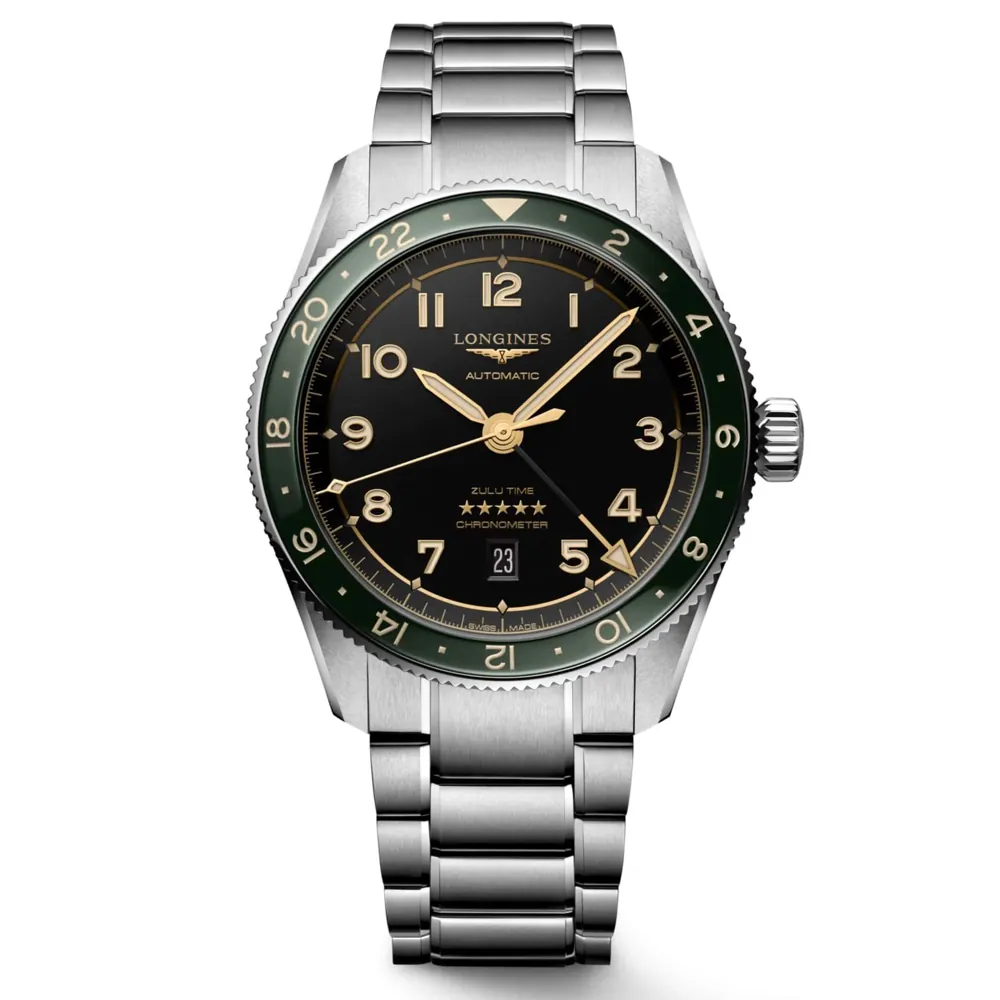
Longines holds a position almost no other Swiss brand manages: nearly two centuries of continuous history, modern movements built to a genuinely high standard, and prices that sit below the point where most buyers start agonizing. It tends to be the brand people arrive at once they stop shopping for a logo and start shopping for a watch.
This guide covers the collections that matter most — the Master Collection, HydroConquest, Spirit and Conquest — along with the heritage reissues, the difference between a column-wheel chronograph and a standard automatic, and what to look at before you commit. Our current Longines stock runs from about $395 to about $5,550, with 66 watches available and most of them new.
Why Longines is the strongest value in Swiss watchmaking
Value is not the same as cheapness. It is the ratio between what you pay and what you get: case finishing, movement quality, design integrity, and a name that will still make sense in twenty years. Judged that way, Longines is difficult to beat.
Part of the reason is structural. Longines belongs to the largest Swiss watchmaking group, sharing industrial capacity with sister brands and using movements developed exclusively for it rather than paying to build a movement factory from scratch. That keeps prices honest, and the savings show up in the things you touch and see — applied markers, properly finished cases, ceramic bezels, anti-reflective sapphire, solid bracelets with usable clasps.
The other part is restraint. Longines does not chase hype references or artificial scarcity. You can simply buy the watch you want, which sounds unremarkable until you have spent a year on a waitlist elsewhere. The trade-off is that it carries none of the speculative resale heat attached to the most hyped steel sports models, and you should not buy one expecting it to. This is a watch to wear, and one of the few Swiss brands where that is unambiguously the better deal.
Heritage that still shows on the dial
Longines was founded in 1832 in Saint-Imier, in the Swiss Jura, and has produced watches under the same name in the same valley ever since. Its winged hourglass emblem is among the oldest registered trademarks in watchmaking and has never been retired or redrawn beyond recognition — a small detail that says a good deal about how the brand thinks.
Two threads run through the archive and both still shape the catalog. The first is aviation and navigation: Longines built pilot's and navigator's watches for some of the era-defining long-distance flights, including large-dial instruments designed with aviators to help calculate position in the air. That lineage is why the Spirit collection exists and why its dials look the way they do. The second is sports timing, which gave the brand decades of chronograph development back when the stopwatch was serious equipment.
What matters for a buyer is that Longines is not inventing a backstory. When it reissues a diver or a sector dial, it is drawing on watches it genuinely made, which is why the heritage pieces feel coherent rather than costumed.
The core collections
Longines runs a wide catalog, but four families cover most of what people actually buy. Each has a clear job.
| Collection | Character | Best for | Typical features |
|---|---|---|---|
| Master Collection | Classic, dressy, traditional | Office wear, formal occasions, a first good watch | Polished cases, applied markers, exhibition casebacks, moonphase and calendar options |
| HydroConquest | Modern dive watch | Water, travel, everyday knockabout wear | Rotating ceramic bezel, screw-down crown, serious water resistance, steel bracelet |
| Spirit | Pilot and instrument | Legibility-first daily wear, travel | Chronometer certification, high-contrast dials, GMT and flyback variants |
| Conquest | Sport-elegant all-rounder | One watch for everything | Integrated-feel bracelets, mixed finishing, quartz and automatic options |
Master Collection
The Master Collection is the traditionalist's Longines and the closest thing the brand has to a flagship. Dials are the point: sunburst and lacquered finishes, applied markers or Roman numerals, blued or leaf hands, and dial printing that holds up under a loupe. Cases are polished and comparatively slim, and most models show the movement through a sapphire caseback.
It is also where the complications live. Moonphase, annual calendar and chronograph variants all sit in this family, priced well below what an equivalent complication costs a tier up. The Master Collection (L2.257.4.87.6) in stock illustrates the register — quietly formal, sized for a shirt cuff, finished more carefully than the price suggests.
HydroConquest
The HydroConquest is Longines' modern diver and one of the most quietly competent watches in its bracket: a unidirectional rotating bezel with a ceramic insert, a screw-down crown, applied luminous markers and a depth rating that covers swimming, snorkeling and recreational diving. The bracelet has a proper diver's extension in the clasp, a detail usually skipped at this price.
Two versions are worth distinguishing. The standard HydroConquest in stainless steel is the straightforward three-hand diver. The HydroConquest GMT (L3.790.4.96.6) adds a second time zone on a 24-hour bezel, turning a pool watch into a travel watch without adding bulk. If you are cross-shopping divers across brands, our dive watch buying guide sets out what genuinely matters in the category.
Spirit
Spirit is the collection that changed how people talk about Longines. It draws on the aviation archive without becoming a costume piece: large legible dials, luminous Arabic numerals, and proportions that wear far better than the pilot-watch category usually manages. The line is chronometer-certified, which is not something you can take for granted at this level.
The Spirit Zulu Time is the standout. It is a true GMT — the local hour hand jumps independently, so you change time zones without stopping the watch — paired with a 24-hour bezel and a dial that stays readable at a glance. Several are in stock, including L3.812.4.63.6, L3.802.4.93.6 and L3.812.4.93.6, plus the Spirit Zulu Time 1925 (L3.803.5.53.6). For regular travelers, this is one of the most complete watches near the money. The Spirit Pilot Flyback (L3.721.4.53.6) covers the other end of the collection, and the three-hand Spirit (L3.410.4.53.6) is its purest expression.
Conquest
Conquest is the everyday sport-elegant line and the broadest family in the catalog. Cases mix brushed and polished surfaces, bracelets are designed to look integrated with the case, and the range spans quartz and automatic. The Conquest (L3.720.4.92.6), the Conquest (L3.830.4.52.6) and the black PVD Conquest 41mm all sit here, as does the Conquest Heritage (L1.649.4.02.6), which takes the name in a more classical direction.
The Conquest V.H.P. deserves its own note. V.H.P. stands for Very High Precision, a quartz movement engineered far beyond ordinary quartz — including a perpetual calendar and a system that detects and corrects hand positions if the watch takes a knock or meets a magnetic field. The Ladies Conquest V.H.P. with a mother-of-pearl and diamond dial is in stock. If quartz feels like a step down, our explainer on watch movements makes the case for why, at this level of engineering, it is not.
Heritage and dress pieces
Around the four pillars sits a set of reissues and classics that are among the most interesting things Longines makes. The Legend Diver (L3.774.4.90.2) revives a 1960s design with an internal rotating bezel worked by a second crown — no crown guards, no bulk, and a shape that looks like nothing else on a wrist today. The Heritage Skin Diver with its black Arabic dial follows similar logic. The Sector Dial (L2.828.4.73.0) revisits the compartmentalized dial layouts of the 1930s, the Flagship (L4.795.4.78.2) carries one of the oldest names in the archive, and the Ultra-Chron Classic (L2.537.4.72.6) revives a high-frequency movement that beats faster than a standard automatic. The PrimaLuna Moonphase (L8.126.4.71.6) and the Mini DolceVita (L5.200.4.75.6) cover smaller-cased dress wear.
Column-wheel chronographs vs standard automatics
This is the technical distinction most likely to affect what you pay, and it is worth understanding before you shop.
What a column wheel actually does
Every chronograph needs a mechanism to coordinate start, stop and reset when you press the pushers. There are two established approaches. A cam-and-lever system uses shaped levers to switch the functions; it is robust, reliable and cheaper to produce. A column wheel uses a small rotating wheel with vertical pillars that raise and lower the levers in sequence as it turns.
Functionally, both keep equally good time. The differences are tactile and industrial. A column wheel gives a cleaner pusher action — a defined click rather than a mushy press — and is considerably more demanding to manufacture and adjust, which is why it has traditionally been reserved for higher tiers. Longines uses a column-wheel chronograph across its serious chronograph models, including the Record Chronograph (L2.921.4.56.6) and the Spirit Pilot Flyback, which adds a flyback function that resets and restarts the timing in one press.
Standard automatics, and why they are not a lesser choice
The time-and-date automatics powering the Spirit, HydroConquest, Conquest and most of the Master Collection are, for most buyers, the more sensible purchase. Current Longines calibers are built to exclusive specifications and typically carry a silicon balance spring, which resists magnetism far better than a traditional metal hairspring. Power reserves run to around three days, so a watch taken off on Friday evening is usually still running on Monday morning.
The guidance is simple. Buy a chronograph if you will use it or genuinely love the look of the subdials, because it costs more, wears thicker and adds service complexity. Buy the three-hand or GMT automatic if you want the best watch per dollar.
Sizing and fit
Longines sizing is sensible rather than fashionable, and most collections offer more than one diameter. The Spirit and HydroConquest run larger, as instrument and dive watches should, but both use short lugs and curved case flanks that keep them wearable on a medium wrist. The DolceVita and PrimaLuna lines cover the smaller end.
Two things matter more than diameter. Lug-to-lug distance — the measurement from lug tip to lug tip — determines whether the watch overhangs your wrist. Thickness decides whether it slides under a cuff. When unsure, err toward the smaller option; almost nobody regrets that direction.
New vs pre-owned
Longines is unusual in that both routes make sense. Because the brand is not supply-constrained, new examples are available at fair prices, and most of our Longines stock is new — full factory condition, unworn bracelets, complete sets.
Pre-owned still earns its place. Discontinued references, earlier dial variants and case sizes no longer in production exist only on the secondary market, and heritage reissues in particular rotate out of the catalog. A carefully inspected pre-owned Longines is a good buy, and the depreciation curve has already flattened by the time you get it. If you are new to buying secondhand, read our guide to buying a pre-owned luxury watch alongside this one.
What to check before you buy
- Reference number. Longines references encode the exact dial, case and bracelet configuration. Confirm the full reference of the individual watch, not just the collection name.
- Dial and hands. Look for even luminous material, crisp printing and no discoloration around the markers. On lacquered heritage dials, check for hairlines in the surface.
- Bezel action. A HydroConquest bezel should turn one way only, with firm defined clicks and no back-play. On a Legend Diver, the inner bezel crown should rotate smoothly and screw down cleanly.
- Bracelet and clasp. Check for stretch by holding the bracelet horizontally, and make sure the clasp snaps shut positively and the micro-adjustment works.
- Crystal and caseback. Sapphire should be unscratched, and an exhibition caseback clear and free of visible corrosion.
- Provenance. Buy from a seller who guarantees authenticity in writing. Our Authenticity Guarantee covers every watch we sell, and each comes with a 2-year movement warranty.
How Longines compares
Within the same group, Tissot sits below Longines with a similar approach and simpler finishing, while Hamilton occupies adjacent ground with an American-heritage accent. Step up and you reach Omega, where in-house movement architecture, higher case finishing and much stronger name recognition arrive with a proportionate increase in price. Tudor competes from a different angle, trading dial variety for tool-watch focus.
The honest summary: Longines gives you most of what the tier above offers in daily use, for meaningfully less, in exchange for brand recognition and resale heat. For a buyer who wants a well-made Swiss watch rather than a status object, that is a good trade.
How to choose
Start with the week you actually have. If you wear a shirt most days and want one watch that reads as serious, the Master Collection is the answer. If you are near water or want something you will not baby, take the HydroConquest. If you travel, the Spirit Zulu Time is the most complete watch here. If you want a single watch that flexes between contexts, Conquest. And if what draws you is a shape nobody else is making, the Legend Diver and the Sector Dial are the interesting ones.
Then set the budget and stop reading. Longines rewards a decisive buyer: the catalog is deep, the prices are fair, and there is no advantage to waiting for a reference to become available. Browse the Longines collection, compare it against the wider catalog, or get in touch if you want a particular reference sourced. Every watch we sell is inspected, guaranteed authentic and shipped insured.