
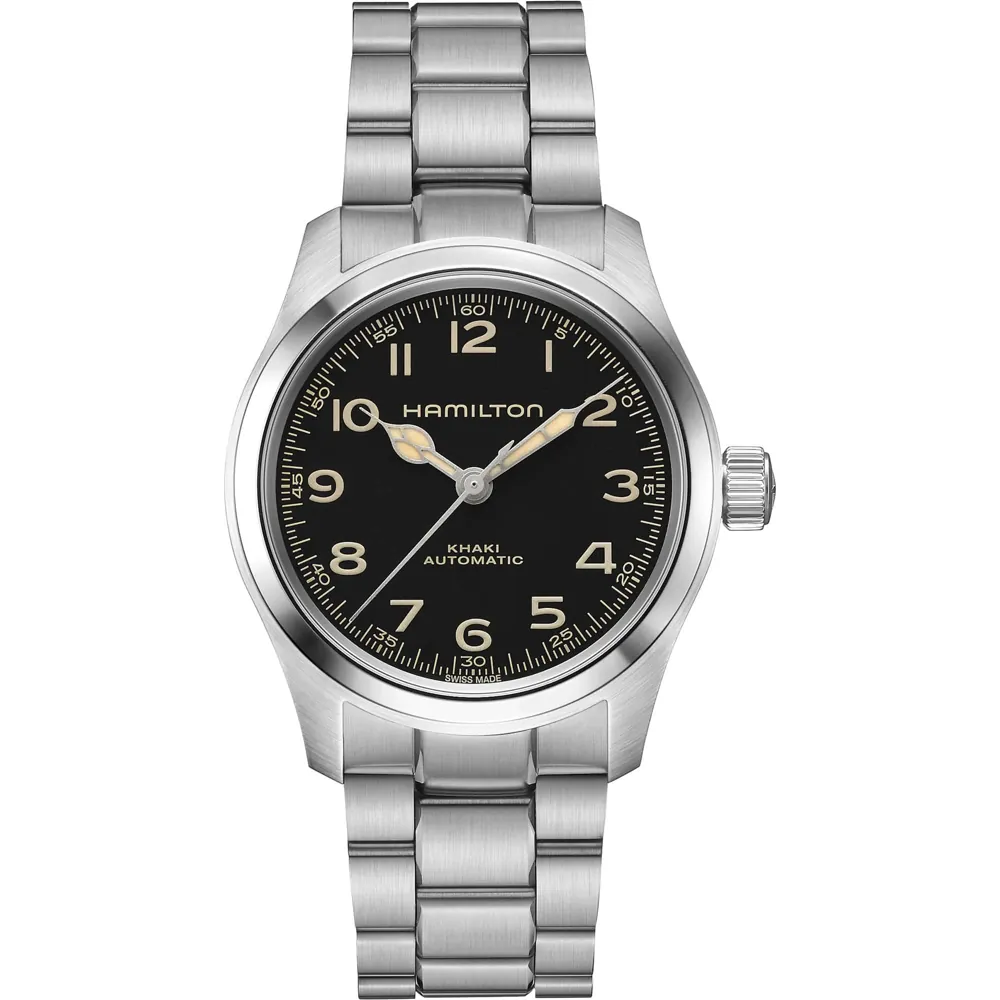
Hamilton occupies an unusual position in watchmaking: an American brand, founded in Lancaster, Pennsylvania in 1892, that has been manufactured in Switzerland for more than half a century. That dual identity is not a marketing story bolted on afterwards. The design language still comes from a railroad and military tradition that began in the United States, while the engineering comes from the Swatch Group's Swiss movement base. Hamilton is, for a great many people, the first serious mechanical watch they own — and often the one they keep long after buying something more expensive.
This guide walks through the collections you are most likely to be choosing between — Khaki Field, Khaki Aviation, Jazzmaster, American Classic and Ventura — explains the movements inside them, and sets out what to look at before you buy. It is written for someone deciding between references rather than someone deciding whether the brand deserves to be taken seriously. It does.
Why Hamilton
Hamilton built its early reputation on accuracy for people who could not afford to be late. American railroads in the late nineteenth century imposed strict standards on the pocket watches their staff carried, and Hamilton became one of the names most closely associated with meeting them. That is the brand's founding character: a watch bought as equipment, judged on whether it worked.
The military chapter followed. Hamilton supplied the American forces through both world wars, turning over civilian production entirely during the second, and made marine chronometers for the Navy alongside the wristwatches issued to troops. The compact, high-contrast field watch that came out of that period is still the shape of the brand's best-selling line today — a watch designed to be legible in bad light by someone with other things on their mind.
From Lancaster to Biel
American manufacturing ended at the close of the 1960s and production moved to Switzerland, where it has stayed. Hamilton now sits within the Swatch Group and is headquartered in Biel. That ownership matters, because it means the watches use movements developed inside the same group that supplies much of the Swiss industry — at specifications that would have been unthinkable at this price a generation ago.
The other thread worth knowing is Hollywood. Hamilton has supplied watches to film productions for decades, and one of those appearances became a permanent part of the catalog: the Khaki Field Murph grew out of the watch made for a 2014 science-fiction film.
The Khaki Field: the heart of the range
If you buy one Hamilton, statistically it will be a Khaki Field. The formula barely changes across the line — a matte or lightly finished case, a high-contrast dial with an outer twenty-four-hour track, luminous numerals, syringe or baton hands, and a strap or bracelet that does not draw attention. It is a design that has aged well because it was never fashionable in the first place.
The variants are where the decision actually lies. The Khaki Field Murph 38mm (H70405130 and H70405730) is the vintage-leaning interpretation, sized small enough to read as a period piece. The plain Khaki Field references (H70455133, H70455140, H70455160, H70605140) cover the mainstream automatic options in different dial and strap combinations. The Khaki Field Mechanical (H69439931) drops the rotor entirely for a hand-wound movement and the thinner case that allows. The Khaki Field Mechanical Power Reserve (H69509130) adds an indicator showing how much winding is left before it stops.
Materials: steel, titanium and bronze
Hamilton offers the Khaki Field in three case materials and they wear very differently. Steel is the default and the most versatile. Titanium — the H70205830, H70545540, H70205140 and H70665533 in current stock — is noticeably lighter on the wrist, warmer against the skin, and more resistant to corrosion, which matters if you sweat in your watch. It also scuffs more readily than steel and does not polish out as cleanly, so treat the marks as part of the deal.
The Khaki Field Bronze (H69459530) is the character option. Bronze develops a patina as it oxidizes, and that patina is unique to how you wear the watch. Some owners love it and some find themselves polishing it back every few months, which rather defeats the point. Buy bronze only if you actively want a case that changes.
Sizing and the rest of the family
Khaki Field cases cluster around 38mm and 42mm, and the difference between them is larger than four millimeters suggests. The 38mm sizes, including both Murph references, sit comfortably on slimmer wrists. The 42mm cases have more presence and more legible dials. If you are between the two, the smaller one is the safer buy — field watches were originally small.
Two other variations are worth knowing. The Khaki Field Expedition (H70225130, H70315110) leans further toward outdoor use, and the Khaki Field King (H64455133) adds a day-date complication in a slightly dressier register. There is also a Khaki Field Quartz (H69401430) for anyone who wants the look without the winding. Browse the current Hamilton collection to see which configurations are actually available — the line rotates.
Khaki Aviation
The aviation side of the Khaki family swaps the field watch's infantry practicality for cockpit legibility. Dials are more open, numerals are larger, and cases are generally bigger to carry them. The Khaki Aviation Pilot Pioneer (H76205530, H76255810) is the clearest expression of the idea — an asymmetric case shape derived from a British military specification, with a dial laid out for reading at a glance rather than for elegance.
The Khaki Aviation Pilot Pioneer Bronze (H76709530) takes the same design into a patinating case, and the Khaki Aviation Pilot Day Date (H64635140) adds two calendar windows. Aviation models generally wear larger than their Khaki Field equivalents, so if a 42mm field watch is already at the top of your comfort range, try before you commit.
Jazzmaster, American Classic and Ventura
Hamilton is not only a tool-watch brand, and the dressier collections are frequently overlooked. The Jazzmaster (H32475130) is the everyday smart option — cleaner dial, slimmer case, more polished surfaces than anything in the Khaki lines. The Jazzmaster Open Heart (H32675540) cuts an aperture in the dial to expose the balance wheel, and the Jazzmaster Skeleton (H42535560) takes that idea considerably further by removing most of the dial altogether. Both are unusually theatrical for the money.
The American Classic Intra-Matic (H38416711) is the quiet connoisseur's pick: a mid-century-styled watch with a restrained dial and slim case that costs a fraction of what a comparable design commands from a better-known name. If you want a watch that works with a jacket and does not announce itself, it is one of the most convincing options near its price.
The Ventura
Then there is the outlier. The Ventura (H24411732 in current stock) was introduced in 1957 as the world's first electric wristwatch — battery-powered, with a shield-shaped asymmetric case designed by the industrial designer Richard Arbib. It looked like nothing else then and it still looks like nothing else now. Elvis Presley wore one on film, and the design has reappeared in cinema regularly since.
Be honest with yourself about the Ventura: it is a design object you wear, not a versatile daily watch, and people will comment on it. If that appeals, nothing else scratches the itch.
How the collections compare
| Collection | Character | Typical movement | Best for |
|---|---|---|---|
| Khaki Field | Military, high-contrast, understated | Automatic, hand-wound or quartz | A first mechanical watch, daily wear |
| Khaki Field Titanium | Same design, much lighter | Automatic | Comfort, corrosion resistance, active wear |
| Khaki Field Bronze | Patinating case, evolving look | Automatic | Owners who want a watch that changes |
| Khaki Aviation | Cockpit legibility, larger cases | Automatic | Bigger wrists, pilot-watch styling |
| Jazzmaster | Dressier, cleaner, more polish | Automatic, some skeletonized | Office and evening wear |
| American Classic | Mid-century, restrained, slim | Automatic | A quiet dress watch on a budget |
| Ventura | Asymmetric, unmistakable | Quartz or automatic | Design-led buyers who want a statement |
Movements: the H-10, the H-40 and the 80-hour reserve
Hamilton's mechanical range is built on a small number of caliber families developed within the Swatch Group, and two names come up more than any others. The H-10 is the automatic workhorse; the H-40 is its close relative. Both are built around an 80-hour power reserve, which is the specification that changed what a watch at this level is expected to do.
Eighty hours matters more in daily life than the number suggests. A watch with a conventional forty-something-hour reserve that comes off on Friday evening is dead by Sunday. One with eighty hours is still running. If you rotate between two or three watches, that is the difference between a watch you enjoy and one that nags at you. Hamilton has also been specifying Nivachron balance springs — an anti-magnetic alloy developed inside the group — across a growing share of the mechanical range.
Hand-wound and quartz options
Hamilton is one of the few mainstream brands still making genuinely hand-wound watches at accessible prices. The Khaki Field Mechanical has no rotor, which makes the case slimmer and puts the daily ritual of winding back into ownership. Some people find that tedious and some find it the whole point. The Mechanical Power Reserve adds an indicator so you can see where you stand rather than guessing.
Quartz has an honest place in the lineup too. The Khaki Field Quartz and Ventura Quartz are accurate, low-maintenance, and cheaper to run — no service intervals, just a battery every few years. There is no snobbery worth entertaining here: a quartz watch you wear constantly beats a mechanical one you find inconvenient. Our guide to watch movements explained covers the trade-offs if you are still deciding.
Where Hamilton sits, and what it costs
Hamilton is the classic entry point into Swiss mechanical watchmaking, and it is worth understanding the neighborhood. Tissot sits alongside it within the same group with a broader, more design-varied catalog. Longines is a step up in finishing and price with stronger dress credentials. Above that, Oris and Tudor compete on in-house engineering and tool-watch heritage.
What Hamilton does better than almost anyone is deliver a Swiss mechanical movement with a long power reserve, a design with real history behind it, and build quality that does not feel like a compromise — at an accessible price. Our roundup of the best luxury watches under $5,000 puts the brand in wider context.
On pricing: current Hamilton stock here runs from about $445 to $2,645, across 45 watches. Unusually for our catalog — where most of the 650 watches across 40 brands are pre-owned — nearly all of that Hamilton stock is new, with a single pre-owned piece. That is worth knowing, because it changes what you need to check.
Buying and living with a Hamilton
Because most Hamilton stock is new rather than secondhand, the usual pre-owned anxieties are largely absent. Still, a few things are worth confirming whatever the condition.
What to check
- The reference number. Hamilton references are long and precise — H70405130 and H70405730 are the same Murph in different configurations. Confirm the exact reference rather than the model name, because dial color, strap and bracelet choices all live in those digits.
- The movement type. Automatic, hand-wound and quartz versions of similar-looking watches exist across the Khaki Field line. Know which one you are buying.
- Case size. A 38mm and a 42mm field watch photograph almost identically and wear nothing alike.
- What is in the box. Extra straps, the warranty card and the original packaging all matter if you ever resell.
- Water resistance. Khaki models are built for daily wear and the occasional swim rather than diving. If the water is the point, look at a purpose-built diver instead.
Every watch we sell is inspected and covered by our Authenticity Guarantee and a 2-year movement warranty, with free insured US shipping and 14-day returns.
Living with one
A Hamilton is an easy watch to own. The mechanical models need periodic servicing like any other, but the cost is proportionate to the watch rather than punishing, and independent watchmakers handle Swatch Group calibers routinely. Strap changes are cheap and transform the character — a Khaki Field on a bracelet, a leather strap and a NATO is effectively three watches. Our watch care guide covers storage, winding and travel.
Prices also sit low enough that you will actually wear the watch rather than protect it, and the watch you reach for without thinking is worth more to you than the one you are careful with.
How to choose
Match the watch to how you live. Khaki Field for a versatile daily mechanical watch, in 38mm if you want the classic proportions and 42mm if you want presence. Titanium if weight matters, bronze if you want a case with a life of its own. Khaki Aviation for a larger, more legible watch with cockpit character. Jazzmaster or American Classic Intra-Matic for dressier wear. Ventura if you want the one watch nobody else in the room will be wearing.
Browse the full Hamilton collection, compare it against the wider catalog, or get in touch if you want help choosing between two references. Hamilton rewards buyers who think about what they will actually wear rather than what will impress — which is, in the end, the only useful way to buy any watch.