
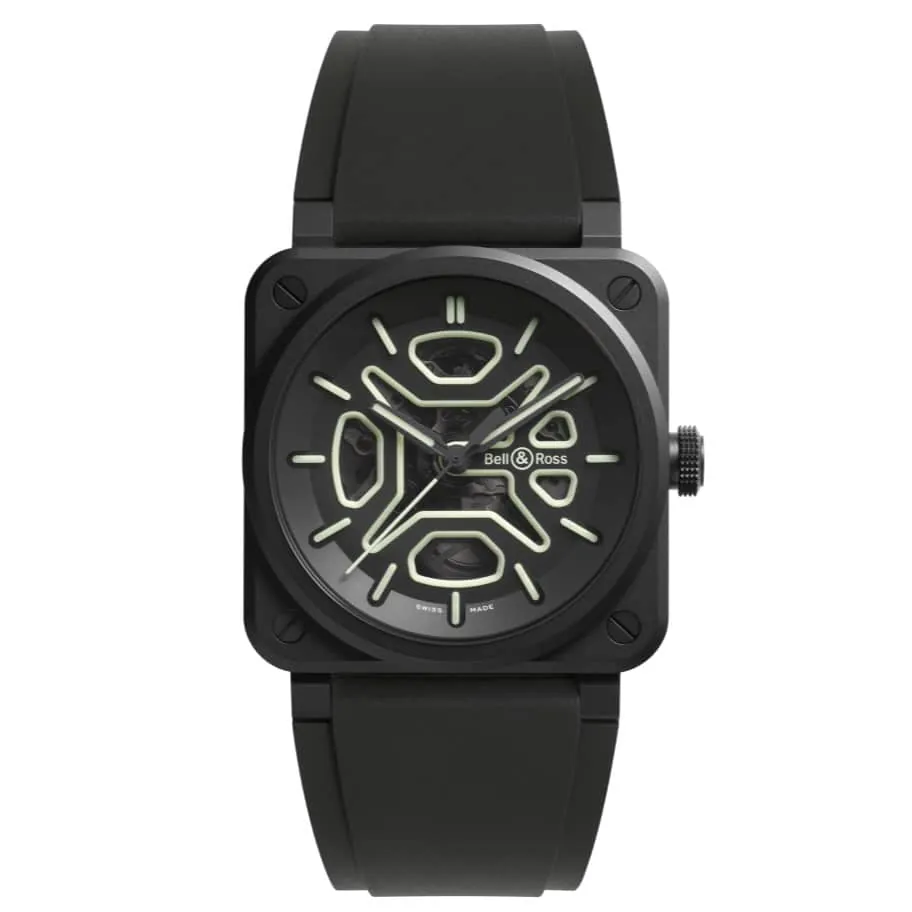
Bell & Ross is the rare watch brand whose signature design can be explained in one sentence: it is an aircraft cockpit clock with a strap on it. A round dial sits inside a square housing, held down by four screws at the corners, exactly as an altimeter sits in an instrument panel. Nothing about it is subtle, and none of it is accidental.
This guide is for someone deciding which Bell & Ross to buy rather than whether the look appeals — that part you know within seconds of seeing one. It covers where the square case came from, how the BR 01, BR 03, BR 05 and BR-X5 differ, what the round V-series does instead, how to read the model numbers, and how a square case actually sits on a wrist. If buying secondhand is new to you, read it alongside our guide to buying a pre-owned luxury watch.
A young brand with an old brief
Bell & Ross was founded in Paris in 1992 by Bruno Belamich and Carlos-Antonio Rosillo — the name is simply their two surnames shortened. Belamich came from design, Rosillo from business, and the pair set out to make watches for people who use instruments professionally: pilots, divers, bomb disposal teams, military units. That is a well-worn claim in this industry, but here it genuinely shaped the product.
The brief has four parts, stated consistently ever since: legibility, functionality, precision, water resistance. What makes the brand unusual is not the list but its willingness to let the first item override aesthetic convention entirely. A watch that is easier to read in bad light is, by this logic, a better watch, even if it ends up looking like equipment bolted to your arm.
The square case and where it came from
The BR 01 made the brand's name, and it is a near-literal transcription of a cockpit instrument. Aviation panel gauges are round dials mounted in square bezels, because a square flange is what you can screw flat against a panel. Bell & Ross kept the whole arrangement — the company's own shorthand for it is a circle in a square with four screws — and added a wide strap on short stubby lugs.
The details matter more than the silhouette. The screws read as fasteners rather than decoration, and their heads are aligned rather than left at random angles. Case surfaces are matte more often than polished, because a glare-free instrument is easier to read, and the crown is large and knurled so it can be worked with gloves on. Once you see the logic, the watch resolves from a styling exercise into a set of answers.
BR 01 versus BR 03
The BR 01 came first, at 46mm square, and it is enormous — genuinely a display-case-sized object worn on a wrist. The BR 03 is the same design scaled down, at 42mm for most of its life and 41mm in the current generation. For most wrists the BR 03 is not the compromise version but the correct one; the BR 01 is for people who want the full statement and have the forearm to carry it.
The BR 05 and the softened square
The BR 05 rounds the square case into a cushion form with an integrated bracelet, moving the design out of the cockpit and into the city. It is the most conventional watch the brand makes and the easiest to wear with a jacket. The BR-05 Skeleton in black ceramic and the BR-05 GMT on a steel bracelet show both ends of that line.
Legibility as the whole point
Every design decision that looks aggressive is usually a legibility decision. The numerals are large and set close to the dial edge. The minute track is graduated rather than implied. The hour and minute hands are shaped differently enough that you cannot confuse them in a fast glance — a real failing on many otherwise elegant watches. Lume is applied generously rather than as a thin outline.
The idea goes furthest on the Lum dials, where the luminous compound covers the entire dial surface rather than just the markers, so the watch reads as a bright panel with dark hands over it. The BR-03 Skeleton Lum in ceramic and the BR-03 Diver Full Lum are the versions in stock: polarizing in daylight, completely convincing in the dark. The BR 03 Military applies the same thinking, pairing a muted ceramic case with a high-contrast dial.
Reading the model names
The naming is more decodable than most, with one wrinkle. The first number is the case family — 01 for the large square, 03 for the smaller square, 05 for the rounded-square integrated-bracelet case, X5 for the high-end line, V for the round vintage-styled cases. On older references a second number describes the function:
- -92 — the three-hand automatic, with or without a date. The default.
- -93 — a second time zone, usually with a 24-hour hand and bezel.
- -94 — a chronograph.
The wrinkle is that the current generation of the square case dropped the function suffix, so newer pieces are simply BR-03 while older ones are BR 03-92. Both conventions sit side by side in our stock. When comparing two listings, the full reference code is the thing to check: BR0392-D-BL-ST/SRB and BR03A-D-LM-CE/SRB are both square divers, and they are not the same watch. The letters carry the case material and the dial treatment.
| Line | Case | Best for |
|---|---|---|
| BR 01 | Large square, 46mm | Maximum presence, broad wrists |
| BR 03 | Square, 42mm and now 41mm | The signature design in a wearable size |
| BR 05 | Rounded square, integrated bracelet | Daily wear, office, travel |
| BR-X5 | Rounded square, manufacture caliber | The most finished option |
| BR V-series | Round, vintage-styled | Aviation heritage without the square |
The collections in stock
The BR 03 divers
A square dive watch sounds like a contradiction and works better than it should — the BR-03 Diver was the first of its kind, and it meets the international standard governing what may be called a diving watch. It puts a unidirectional timing bezel inside the square bezel, adds a screw-down crown and a properly sealed case, and keeps the oversized lume. We stock the black steel BR 03-92 Diver, a black matte ceramic version, a white-dial version, and a bronze-cased Black & Green edition. For what matters across the category, our dive watch buying guide is the companion piece.
The HydroMax Professional
The HydroMax is the outlier in the Bell & Ross catalog. Its reference, 11100, is its depth rating in meters — so far beyond recreational diving that it belongs to a different category of engineering. It gets there by filling the case with fluid, leaving no compressible air space for pressure to crush, and uses quartz because that is the right tool for the job.
The BR-X5
The BR-X5 sits at the top of the range. It uses the rounded-square case with an integrated bracelet, adds a power-reserve indicator to the dial, and runs a manufacture caliber rather than a shared base movement. The BR-X5 Black Steel is the example in stock.
The round watches
Not everything here is square. The V-series draws on mid-century pilot's watches: round cases, simple bezels, and dials that keep the legibility discipline without the instrument-panel framing. The Vintage 126 in stock is a round chronograph from this side of the catalog — the piece to try if the square case has never quite convinced you.
Sizing: the square case problem
This section saves people money, because fit is the most common reason a Bell & Ross goes back in the box. A square watch covers dramatically more wrist than a round watch of the same nominal size, and the specification number will mislead you.
Why the number understates it
A round 42mm case measures 42mm in every direction. A 42mm square case measures 42mm across the flats but close to 59mm across the diagonal, and covers roughly a third more surface area. The corners are the problem: they sit where a round case has curved away to nothing, so they press against the edges of the wrist and catch on cuffs.
Measure lug-to-lug, then measure your wrist
The number to care about is lug-to-lug — the distance from the top of the case to the bottom, measured along your arm. On a square Bell & Ross the lugs are short stubs, so the case is nearly the whole measurement, and it is flat rather than curling down to meet the wrist. Measure the flat top of your wrist between the points where it starts to curve away, and compare. If lug-to-lug is larger, the watch will overhang and rock, and no strap adjustment fixes it.
| If you | Look at | Why |
|---|---|---|
| Have a broad, flat wrist | BR 01 or any BR 03 | The square case needs flat real estate |
| Have a narrower wrist | BR 03, current generation | The design in its least demanding proportions |
| Wear a cuff most days | BR 05 or the V-series | Rounded and round cases slide under a sleeve |
| Want the boldest look | BR 03 Full Lum or Skeleton | Presence from the dial, not more millimeters |
| Want one watch for everything | BR 05 GMT | Bracelet, travel function, conventional proportions |
Materials and straps
Ceramic is the material to understand first, because Bell & Ross uses it more than almost anyone at this level. A matte black ceramic case will not scratch in normal wear, holds its finish indefinitely, and is lighter than steel — which matters on a case this large. The trade-off is brittleness: ceramic resists scratches far better than steel but tolerates a hard knock on a corner far worse, and it cannot be refinished. On a square case with four exposed corners, that is worth thinking about.
Bronze, as on the Black & Green Diver, behaves the opposite way. It is meant to change: air and moisture develop a patina that darkens the case over months, so every example ends up slightly different. Steel remains the versatile default and the easiest to refresh at service, and the Copper version is the warmest, least severe watch in the range.
Straps matter more here than on a round watch, because the wide lugs and flat case mean a change alters the whole object. Rubber and synthetic fabric suit the tool character, leather softens it, and a bracelet on the BR 05 turns it into something else entirely.
Buying Bell & Ross pre-owned
The general secondhand checks apply, and several are specific to these watches:
- Confirm the full reference code. Model names repeat across materials and dial colors; the code on the caseback and paperwork identifies the exact watch.
- Look closely at the corners. They take every knock — check ceramic for chips, and steel for edges rounded off by polishing.
- Check the four screws. The heads should be intact and aligned, not chewed by a slipped screwdriver.
- Work the bezel on a Diver. It should turn one way only, with defined clicks and minimal back-play.
- Inspect a Full Lum dial. Coverage should be even across the surface, with no patchiness or lifting at the edges.
- Ask about pressure testing. Water resistance depends on gaskets that age. Ask when a diver was last tested rather than reading the caseback.
The fakes concentrate on the most recognizable square models, where a broadly correct silhouette is easy to approximate and the finishing is not. Our guide to spotting a fake luxury watch covers the general tells; here, look hardest at the crispness of the printing, the alignment of the screws and the quality of the lume. The stronger protection is provenance: every watch we sell is inspected and covered by our Authenticity Guarantee, a 2-year movement warranty and a 14-day return policy.
One point on supply. Bell & Ross is a smaller brand than most of its neighbors and the secondhand pool is correspondingly shallower, so a specific reference and dial color can take patience to find. Current Bell & Ross stock runs from about $2,495 to $10,100 across thirteen watches, most of them new rather than pre-owned — a different balance from the rest of our 650-watch catalog.
Where to start
For a first Bell & Ross, the square BR 03 in steel or black ceramic is the obvious answer. It is the design at its most recognizable, in the size that suits the widest range of wrists, and it teaches you quickly whether the format is for you. If you already suspect the square case is too much watch, buy a BR 05 or a round V-series piece and enjoy wearing it rather than owning the more famous shape and leaving it in a drawer.
Cross-shopping, the natural comparisons are brands that treat instrument character as the point rather than a theme. Panerai does it with a cushion case and sandwich dials, IWC with the classical pilot's watch tradition, and Hamilton at a much lower price with its field and aviation lines.
When you are ready, browse the Bell & Ross collection to see what is in stock, or get in touch if you want a particular reference sourced.