
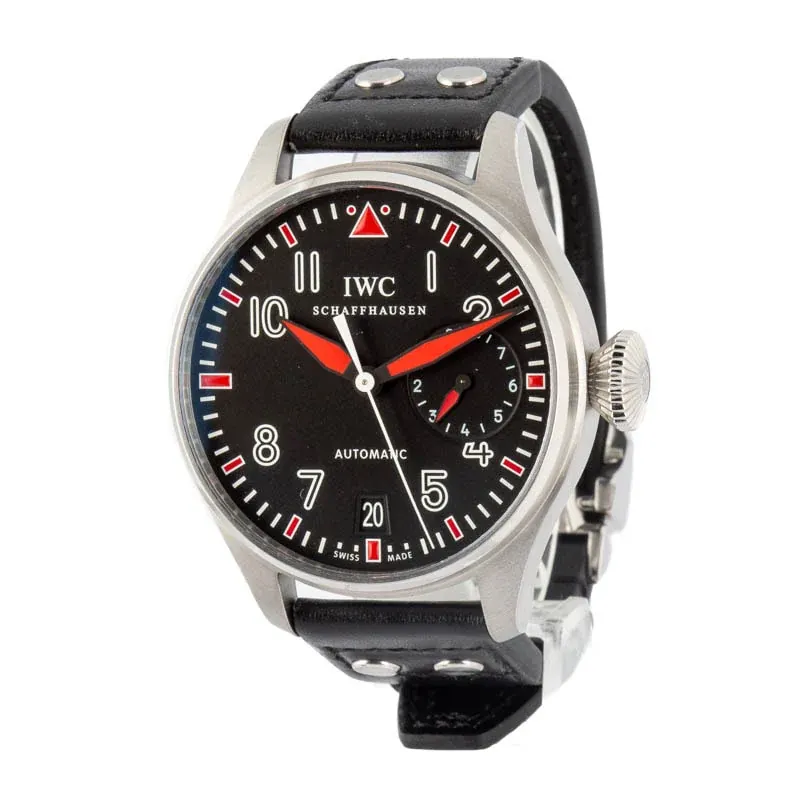
IWC Schaffhausen is the rare Swiss watch brand founded by an American. Florentine Ariosto Jones arrived in Schaffhausen in 1868 intending to combine American machine-made production methods with Swiss hands, using water power drawn from the Rhine. The plan did not survive the economics of the era, but the factory did, and IWC has built watches on the same site ever since.
That engineering-first origin still shapes the catalog. IWC makes fewer collections than most brands at its price level, and each exists for a reason. This guide covers the four that matter, explains why IWC reference numbers are worth learning to read, sets out how the case sizes wear, and lists what to check before buying pre-owned. If the secondary market is new to you, read it alongside our guide to buying a pre-owned luxury watch. Our current IWC stock is 24 watches, all pre-owned, running from $2,195 to $20,995.
The four pillar collections
IWC's range has been pruned repeatedly, and what remains rests on four pillars: the Pilot's Watches, the Portugieser, the Ingenieur and the Aquatimer. Everything else, the Portofino and Da Vinci included, orbits those four.
| Collection | Character | Typical size | Best suited to |
|---|---|---|---|
| Pilot's Watch | Military legibility, matte dials | 40mm to 46mm | Casual daily wear |
| Portugieser | Restrained, pocket-watch proportions | 41mm to mid-forties | Business and formal wear |
| Ingenieur | Integrated bracelet, antimagnetic roots | 40mm to 42mm | One-watch owners |
| Aquatimer | Dive tool with a rotating bezel | Mid-forties | Swimmers and divers |
Pilot's Watches
This is the collection most people meet first, and it splits neatly in two. On one side sits the Mark line, descended from the military observation watches IWC supplied to the Royal Air Force in the mid-twentieth century: a plain black dial, a triangle at twelve, a soft-iron inner case for magnetic protection, nothing else. The Mark XX carries that brief forward almost unchanged, and the two in stock, IW328207 and IW328205, are at 40mm among the most wearable watches IWC makes.
On the other side sits the Big Pilot, drawn from the oversized navigation watches of the same period, worn over a flight jacket rather than under a cuff. The classic Big Pilot, including the IW500433 in stock, is 46mm and makes no apology for it; the Big Pilot's Watch 43 TOP GUN IW329801 shrinks the format to 43mm in black ceramic. Between the extremes sit the chronographs, including the Pilot's Watch Chronograph 41 IW388117, the version most people find they can wear every day.
Portugieser
The Portugieser is IWC's dress collection, though calling it a dress watch undersells how large and legible it is. The brand's account of its origin is that two Portuguese merchants asked for a wristwatch with the accuracy of a marine chronometer, which in the 1930s meant fitting a pocket-watch movement into a wristwatch case. Hence the size, the thin bezel, the open dial, the Arabic numerals and the railway-track minute scale.
It is also where IWC puts its complications. Stock includes the Portugieser Chronograph in two executions, IW371601 and IW371624; the Automatic in IW500702 and IW500113; the Perpetual Calendar IW502213, built on the module behind IWC's calendar reputation; and the Grande Complication IW377602, which stacks a perpetual calendar, a chronograph and a chiming complication into one case.
Ingenieur
The Ingenieur began in 1955 as an antimagnetic watch for engineers, with a soft-iron cage around the movement to shield it from industrial magnetic fields. Its more famous chapter came in the 1970s, when Gerald Genta gave it an integrated bracelet, a bezel with functional bores and the angular geometry that defined the era's luxury sports watches. IWC returned to that design with the Ingenieur Automatic 40.
Two are in stock and they show the range: the Ingenieur Automatic 42 IW338903 in ceramic and the Ingenieur Automatic 40 IW328904 in titanium. The integrated bracelet decides it for most buyers. It wears beautifully, but you cannot swap it for a strap the way you can on a Pilot's Watch, so the watch you buy is the watch you get. For someone who wants one watch for the office and the weekend, that is a feature.
Aquatimer
IWC's dive line dates to 1967. Its most interesting engineering is the internal rotating bezel driven by an external ring, which you can operate with gloves or wet hands while the timing scale stays protected under the crystal. The Aquatimer Chronograph IW376710 in stock is a mid-forties case and wears like equipment rather than jewelry.
How to read an IWC reference number
Most brands treat reference numbers as inventory codes. IWC's are more useful than that, and learning the pattern will save you money. Every modern reference takes the form IW followed by six digits. IWC has never published an official key, but the structure is consistent enough to be a practical shopping tool.
The first three digits identify the model family and, crucially, the movement platform underneath it. The remaining three identify the execution: case material, dial, bezel, strap or bracelet. That split is where the useful information lives.
- Same first three digits means the same platform. IW500433 is a 46mm Big Pilot and IW500702 is a Portugieser Automatic. They look nothing alike, but the shared leading digits point to the same seven-day automatic platform inside. Watches from different collections can be more closely related than they appear.
- Different last two digits means the same watch, differently dressed. IW328205 and IW328207 are both Mark XX: same case, same caliber, same size, with the difference in dial and fitment. When two listings differ only in the last two digits, you are choosing on looks, not specification.
- A different leading group means a different watch. IW338903 and IW328904 are both called Ingenieur Automatic, but the leading digits separate the 42mm ceramic from the 40mm titanium.
- The reference outranks the model name. IWC reuses collection names across generations, so IW371601 and IW371624 are both Portugieser Chronographs. The last digits tell you which one you are buying.
The habit to build is simple: never shop by collection name alone. Get the full six-digit reference, confirm it matches the engraving and paperwork, and search on that. It is the fastest way to tell whether a price is fair.
Case sizes and what they actually wear like
IWC sizing spans a wider range than most comparable brands, and diameter matters more here than elsewhere. Pilot's Watches have long, straight lugs and flat casebacks, so they do not tuck onto a wrist the way a short-lugged sports watch does.
| Model | Diameter | How it wears |
|---|---|---|
| Big Pilot (classic) | 46mm | Oversized; comfortable only on larger wrists |
| Big Pilot's Watch 43 | 43mm | The same look, at a size most wrists carry |
| Aquatimer Chronograph | Mid-forties | Thick and substantial, as a dive chronograph should be |
| Ingenieur Automatic 42 | 42mm | True to size; the bracelet hugs the wrist |
| Portugieser Chronograph | About 41mm | Wears larger; thin bezel, very open dial |
| Pilot's Watch Chronograph 41 | 41mm | The everyday sweet spot in the line |
| Ingenieur Automatic 40 | 40mm | Compact and formal enough for a cuff |
| Mark XX | 40mm | The most wearable IWC in the range |
The Big Pilot deserves a warning, because it is the watch people most often buy on romance and sell on discomfort. At 46mm it is less a large watch than a different category of object. Some owners wear nothing else; others find the conical crown digs into the back of the hand. Try one on before committing; if the size worries you, take the 43mm version.
Materials: where IWC does things differently
IWC was an early adopter of case materials beyond steel and gold, and this is one area where the brand has a technical claim rather than a marketing one. Ceramic has been in the catalog since the 1980s, and IWC still uses zirconium oxide for full cases rather than just bezel inserts. It is extremely scratch-resistant, does not corrode, and is lighter than steel. The trade-off is brittleness: a hard impact on an edge can chip it, and a chipped case cannot be polished out. The TOP GUN IW329801 and the Ingenieur Automatic 42 IW338903 both use it.
Titanium is the other IWC signature, used since the 1980s. It is roughly half the weight of steel, with a warmer gray tone that some buyers prefer and others find flat. On a large case it transforms the experience — a titanium 42mm can feel lighter than a steel 40mm. It scratches more readily than steel, but the marks blend in. The Ingenieur Automatic 40 IW328904 is the titanium piece in stock.
Bronze appears periodically across the Pilot's line, developing a patina from skin, air and moisture. The watch you own in a year will not look like the one you bought, which is either the appeal or the problem. Gold, in red and white, is used mostly on the Portugieser and the complications.
Movements: the sourced era and the in-house era
This is the part of IWC buying that trips up the most people, because it affects both price and servicing. For much of its modern history IWC built on outsourced bases — a well-established Swiss chronograph caliber under many of its chronographs, third-party automatics under the simpler models. IWC modified, finished and regulated them, sometimes heavily, but the architecture came from outside.
That has changed substantially. IWC now builds several in-house caliber families: automatics in the 32000 group, the seven-day Pellaton-wound calibers in the 52000 group, integrated chronographs in the 69000 group, and the complicated calibers above those. The Pellaton system is worth knowing: a pawl-based winding mechanism developed by IWC's own technical director in the mid-twentieth century, distinct from the rotor-and-reverser arrangement most brands use, and still in production today.
The consequence is that two watches sharing a collection name and looking near-identical in photographs can have different movements. The Mark XX moved to an in-house automatic with a much longer power reserve than the sourced caliber it replaced. The Portugieser Chronograph made a similar transition while keeping its case and dial layout intact; the usual tell is the caseback, since the in-house version is generally shown through sapphire while the earlier one was solid.
Neither era is a mistake to buy. A modified sourced base is proven, serviceable and widely understood, with excellent parts availability. But know which you are buying, because the market prices them differently. Our explainer on watch movements covers the distinction.
Buying an IWC pre-owned
IWC holds its value respectably rather than spectacularly, which is good news for a buyer: depreciation from retail is meaningful, and the secondary market is where the brand makes the most sense. Every piece across our IWC listings is pre-owned. Here is what to look at.
- Confirm the full reference. Check the six digits on the caseback or paperwork against the listing. Collection names are reused across generations; references are not.
- Identify the movement generation. Ask whether the caliber is in-house or a modified sourced base. On chronographs this is the largest driver of value within a family.
- Inspect ceramic edges. Scratches are not the risk; chips are. Examine the bezel edge, lug tips and crown guards under good light.
- Check titanium finishing. Titanium refinishes, but poor work softens the transitions between brushed and polished surfaces.
- Test the crown and bezel. A Big Pilot's conical crown should screw down with no grit, and the Aquatimer's external ring should drive the internal bezel without slop.
- Ask about complication servicing. A perpetual calendar or chiming complication costs more to service than a time-and-date watch.
- Check bracelet originality. Original IWC bracelets, especially integrated ones, are expensive to replace and hard to source.
Counterfeits exist for IWC as for every major brand, the Pilot's and Portugieser lines most of all. Our guide to spotting a fake luxury watch covers the tells, but the reliable protection is provenance. Every IWC we sell is inspected and covered by our Authenticity Guarantee, a 2-year movement warranty and 14-day returns, set out in our refund policy.
Choosing your IWC
Work backward from how you dress rather than from which watch photographs best. If your week is mostly casual, a Mark XX or a Pilot's Watch Chronograph 41 will get worn constantly. If you wear a jacket regularly, the Portugieser is the more natural choice. If you want one watch for both and are happy never to change the bracelet, the Ingenieur is built precisely for that. If you swim or dive, the Aquatimer.
Budget then sets the tier. The lower end of the range buys a time-and-date Pilot's Watch or an entry Portugieser with no compromise in build quality; the upper end buys complications that are as much a servicing commitment as a purchase.
It is worth knowing what IWC competes against. Omega offers comparable engineering with broader recognition; Breitling occupies similar aviation territory with a louder personality; Panerai is the alternative if the appeal of the Big Pilot is really size. IWC's distinguishing quality is restraint, and for a certain buyer that is the point.
When you are ready, browse the full IWC collection, all inspected and guaranteed authentic, or get in touch to have a reference sourced. Whichever you land on, confirm the reference before you pay. With IWC more than most brands, those six digits are the whole story.