
Grand Seiko started in 1960 as an internal argument settled with a product. Seiko set out to build a wristwatch that could stand against the best of Switzerland on accuracy, finishing and durability, then held it to a standard it wrote itself. For most of the following half-century the results stayed in Japan. The line only became widely available outside its home market in 2010, and only became a standalone brand in 2017.
That history explains something odd about the brand today: a company with more than sixty years behind it still feels, to many buyers, like a discovery. This guide covers what separates a Grand Seiko from its price rivals — the three kinds of movement, the polishing, the textured dials, the difference between the Heritage, Sport and Evolution 9 collections, and how to read a reference number.
Why Grand Seiko
Grand Seiko competes on the things that are hard to photograph. It is not a brand built on a single iconic silhouette, a racing story or a moon landing. It is built on case surfaces that are genuinely flat rather than approximately flat, on hands and markers with edges sharp enough to throw a hard line of light, and on movements designed to be more accurate than the category norm rather than accurate enough to pass. It rewards close attention and does not shout across a room. If you want a watch a stranger recognizes at a glance, this is not that brand.
The other structural point is vertical integration. Grand Seiko makes its own movements, hairsprings and escapements, its own dials and cases, and for the quartz calibers grows its own crystals. Two studios do the work: Shizukuishi in Iwate prefecture handles the mechanical watches, and Shinshu in Nagano handles Spring Drive and the high-accuracy quartz. Very few watch companies at any price control that much of their own production.
The three engines: Spring Drive, Hi-Beat and 9F quartz
Almost every meaningful decision about a Grand Seiko starts with which movement family you want, because it changes how the watch behaves on the wrist far more than the dial color does.
Spring Drive
Spring Drive is the brand's signature and the hardest to explain in a sentence. It is a mechanical watch — mainspring, barrel, going train, self-winding rotor — but the escapement is replaced by an electronic regulator. The train drives a rotor that generates a small current, a quartz oscillator and integrated circuit compare its speed against a reference, and an electromagnetic brake trims it continuously. There is no battery; all the energy still comes from the mainspring.
Two things follow. Accuracy is quoted per month rather than per day, which puts it ahead of what a conventional escapement can hold. And the seconds hand glides rather than ticks — a continuous sweep with no steps at all, because nothing inside is stopping and releasing. It is the most distinctive thing about the brand, and the reason many people buy their first one. Our guide to watch movements explained sets Spring Drive alongside conventional automatics and quartz.
Hi-Beat 36000
Hi-Beat is the purely mechanical answer, and the name is literal: the balance runs at 36,000 vibrations per hour, or ten beats per second, against the 28,800 most modern automatics use. A faster balance is less easily disturbed by shocks and wrist movement, which helps it hold rate, and it gives a visibly smoother sweep — not the glide of Spring Drive, but noticeably finer than four beats per second. Running fast costs energy and wear, which is why lubrication and escapement materials matter so much here. If the idea of an electronic regulator bothers you on principle, this is where to look.
9F quartz
The 9F is the reason it is a mistake to dismiss the quartz Grand Seikos. It is a high-accuracy caliber built to mechanical-watch standards of construction: a twin-pulse motor that can drive larger, heavier hands than ordinary quartz, a backlash mechanism that stops the seconds hand shuddering as it settles on a marker, a date that snaps over instantly rather than creeping, and a sealed construction meant to be serviced rather than swapped. These are usually the most affordable way into the brand, and also the thinnest and lowest-maintenance.
| Spring Drive | Hi-Beat 36000 | 9F quartz | |
|---|---|---|---|
| Power source | Mainspring, self-winding | Mainspring, self-winding or manual | Battery |
| Regulation | Quartz-referenced electromagnetic brake | Escapement at 10 beats/second | Quartz oscillator |
| Seconds hand | Continuous glide, no steps | Smooth sweep, very fine steps | One precise step per second |
| Reference prefix | SBGA, SBGE, SLGA | SBGH, SBGJ, SLGH | SBGX, SBGN |
| Best for | Accuracy with a mechanical soul | Traditionalists who want an escapement | Set-and-forget precision, slimmer cases |
Zaratsu polishing and the Grand Seiko Style
Zaratsu is the term for the mirror polishing Grand Seiko applies to its cases, done by holding the case by hand against the flat face of a spinning tin plate. The point is distortion. An ordinary polished surface bends the reflection slightly, because polishing tends to round the surface it works on. A correctly Zaratsu-polished surface stays flat, so the reflection stays straight and the boundary where a mirror surface meets a brushed one is a hard line rather than a soft transition.
This only matters because of the case geometry it serves. In 1967 Grand Seiko codified a design grammar — usually called the Grand Seiko Style — around flat planes, wide bevels, and the elimination of curved surfaces wherever a flat one would do. Markers and hands are cut with multiple facets and diamond-polished so they catch light as discrete flashes rather than a general shine. A Grand Seiko therefore changes appearance sharply as you move your wrist, which is exactly the quality that photographs badly and reads unmistakably in person. It also means a badly refinished example loses more than it would on a brand with rounder cases.
The dials
The textured dials are the other thing the brand is known for, and the Snowflake is the one that started it. Its surface is stamped to a fine, irregular texture meant to read as wind-blown snow, a reference to the landscape around the Shinshu studio where Spring Drive is built. In white with a titanium case, it made the case that a dial could be the whole point of a watch.
What followed is a family of dials drawn from the surroundings of the two studios — the ridged Mount Iwate pattern taken from the mountain the Shizukuishi studio looks out on, birch bark, cherry blossom, frost and lake surfaces, in whites, greens, blues and grays. The effect is directional: these dials shift considerably between office light, daylight and shade, so judging one from a single photograph tells you very little. The texture is a property of the dial itself rather than a printed finish, so it does not wear off.
Heritage, Sport and Evolution 9
The modern catalog splits into three collections, plus the dressier Elegance line, and the split is more useful than it first looks.
Heritage
Heritage is the core: classic proportions, mostly time-and-date, drawing directly on the 1960s designs and the Grand Seiko Style. This is where the Snowflake and most of the nature dials live, and it spans all three movement families. Current stock includes the Hi-Beat GMT SBGJ259 with a green dial, the blue-dial Hi-Beat SBGH273, the limited-edition SBGH333, the quartz SBGX355 in white, and the Spring Drive SBGA375 in blue.
Sport
Sport covers the divers, the GMTs and the tougher-cased models: thicker cases, higher water resistance, luminous handsets, action bezels, and bracelets built for real wear. The design grammar is the same, applied to a watch you would take into the sea. Stock has included several examples of the black-dial Spring Drive SBGA461, the blue-dial Spring Drive GMT SBGE255, and the quartz GMT SBGN019, all of which sit in the Grand Seiko collection alongside the Heritage models.
Evolution 9
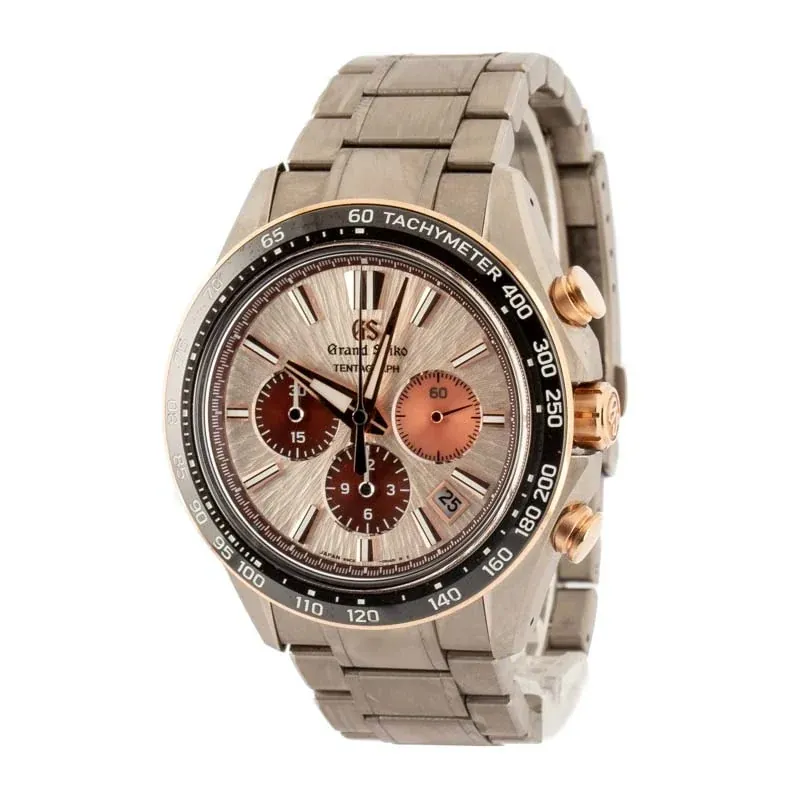
Evolution 9 is the newest of the three and the most significant. Launched at the start of the 2020s, it revises the original design grammar rather than replacing it — wider, flatter bezels, a case profile that sits lower on the wrist, broader hands and markers, and the newest calibers. It is also where the Tentagraph lives, the brand's first mechanical chronograph: a high-beat automatic with a three-day power reserve, which is what the name compresses. The SLGC001 and SLGC006G both appear in current stock.
Reading a Grand Seiko reference
Grand Seiko reference numbers look opaque and are actually among the most readable in the industry. The first letters tell you the generation; the third and fourth characters tell you the movement family.
- SBG… — the long-running series covering Heritage, Sport and Elegance.
- SLG… — Evolution 9 collection references.
- …GA and …GE — Spring Drive, with GE indicating a GMT.
- …GH and …GJ — Hi-Beat 36000, with GJ indicating a GMT.
- …GX and …GN — 9F quartz, with GN indicating a GMT.
- …GC — the Tentagraph chronograph.
- …GR and …GW — standard-beat automatic and manual-winding mechanical.
So SBGJ259 is a Hi-Beat GMT, SBGA461 is a Spring Drive, and SLGC006G is an Evolution 9 Tentagraph, all confirmed at a glance. Always match the reference on the caseback to the description you were given, because visually similar watches here routinely carry completely different movements.
Grand Seiko against the Swiss competition
At the price points where Grand Seiko sells, the honest comparison set is the upper end of Omega, steel Rolex on the secondary market, and the dressier end of Tudor. On finishing, Grand Seiko usually wins outright — case polishing and hand and marker work at this price are better than the category norm. On accuracy, Spring Drive and the 9F quartz are ahead of what standard chronometer certification requires, and Hi-Beat is at least competitive.
Where the Swiss brands lead is recognition and resale. A Rolex is understood by everyone and sells in an afternoon; a Grand Seiko is understood by enthusiasts and takes longer to move. That gap is narrower than it was, but it is real, and if resale is high on your list you should weigh it honestly before committing. If you are buying because you want to wear the watch, the calculation flips. Service is the other practical difference — Grand Seiko is serviced through Seiko's own network, and Spring Drive in particular is not something a general independent watchmaker can work on.
Buying Grand Seiko pre-owned
Grand Seiko is a good brand to buy used. Depreciation from retail is steeper than for the big Swiss names, which is bad news if you are selling and distinctly good news if you are buying. We currently hold 14 Grand Seiko watches, all pre-owned, within a wider catalog of 650 watches across 40 brands, and current Grand Seiko stock runs from about $200 to just under $12,000. For the broader process, how to buy a pre-owned luxury watch covers the ground end to end.
What to check
- Case finishing. Look at this first, not last. Sight along the flanks: mirror surfaces should reflect a straight line, and the boundary between polished and brushed areas should be a crisp edge. Waviness or a softened bevel means a poor refinish.
- Reference and movement agreement. Confirm the caseback reference matches the movement you were told you are buying. The prefix logic above makes this quick.
- Spring Drive behavior. The seconds hand should glide with no hint of stepping, and the power reserve indicator, where fitted, should respond as you wind.
- Quartz service history. On a 9F, ask when the battery was last changed and by whom. These calibers are meant to be serviced properly rather than opened casually.
- Bracelet condition. Hold it horizontally from the clasp and look for sag and lateral play. Grand Seiko bracelets are well built, but links wear.
- Dial and crystal. Textured dials show marks readily under angled light. Check in more than one lighting condition.
Counterfeit Grand Seiko exists but is less common than for the major Swiss brands; the realistic risks are misrepresented condition and poor refinishing. Our guide to spotting a fake luxury watch covers the authentication basics. Every watch we sell is inspected and covered by our Authenticity Guarantee and a 2-year movement warranty, with free insured US shipping and 14-day returns.
How to choose
Work backward from the movement. If the glide of the seconds hand is what drew you to the brand, buy Spring Drive and choose the dial second. If you want a conventional mechanical watch, buy Hi-Beat. If you want something slim, accurate and effectively maintenance-free, buy a 9F quartz and ignore anyone who tells you quartz is beneath the price. Then pick the collection: Heritage for a formal or everyday watch, Sport if it needs to survive water and knocks, Evolution 9 for the current generation of case design and calibers.
Then see the dial in person if you can, because that is the part that photographs least honestly. Browse the Grand Seiko collection, compare it against the rest of the catalog, or get in touch if you want a particular reference sourced. This is a brand that rewards the buyer who takes their time over the one who moves fastest.